

 by
by Figuring out how to get from central London to Victoria Coach Station might feel like a puzzle, but it’s actually pretty simple once you know your options. You’ve got three main ways to do it: a direct taxi for pure convenience, the cheap-and-cheerful TfL bus network, or the speedy London Underground.
The best one for you really boils down to your budget, how much time you have, and how much luggage you’re dragging along.
Getting to Victoria Coach Station Simplified
A little bit of planning goes a long way when you’re heading to one of the UK’s busiest transport hubs. Whether you’re a tourist arriving from Manchester or a local just crossing town, knowing how you’ll get there makes for a much calmer start to your trip. The station’s prime location in Westminster means it’s well-connected, but this is London—so travel times can be a lottery.
Each transport choice strikes a different balance between cost, speed, and ease. For example, pre-booking a car through an app like Crisfix takes all the guesswork out of navigating public transport with heavy bags. On the flip side, if you’re travelling light, hopping on the Tube is almost always the fastest way to get there.
Why This Station Is a Big Deal
Victoria Coach Station isn’t just another bus stop; it’s the capital’s main coach terminal. Run by Victoria Coach Station Limited (which is part of Transport for London), it’s a massive hub for travel across the UK and into Europe.
Its importance is clear from the sheer number of people passing through. Before the pandemic, it hit a peak of 14.5 million passengers, up from 9.5 million in 2008. While those numbers took a hit, they’re bouncing back, showing just how much people rely on coaches. You can see more stats on the station’s history and passenger trends on Wikipedia.
With a constant stream of travellers coming in from cities like Birmingham, Liverpool, and Newcastle, getting to and from the station smoothly is non-negotiable.
Your Main Travel Choices
So, how are you going to get there? Let’s break down your main options.
To make things even clearer, here’s a quick rundown of your choices so you can compare them side-by-side.
Travel Options to Victoria Coach Station at a Glance
| Transport Method | Average Cost | Average Travel Time | Best For |
|---|---|---|---|
| London Underground | £2.80 (off-peak) | 15-25 mins | Speed and avoiding traffic |
| TfL Bus | £1.75 | 30-50 mins | Budget travel and sightseeing |
| Taxi/Ride-Share | £15 – £40+ | 20-40 mins | Convenience and heavy luggage |
This table should give you a good starting point, but let’s dive a bit deeper into what each option really means for your journey.
- London Underground (The Tube): This is often your fastest bet for cutting across London, as it completely bypasses road traffic. Victoria Station is a major interchange served by the Victoria, District, and Circle lines, making it super accessible.
- TfL Buses: A far more budget-friendly choice that doubles as a mini-tour of the city. Several bus routes stop right outside the coach station or just a short walk away.
- Taxi or Ride-Sharing: This is the undisputed winner for convenience, especially if you’re loaded with luggage. Services like the Crisfix app, Uber, Bolt, or Addison Lee offer a door-to-door ride, so you don’t have to worry about a thing.
Picking the right transport is always a trade-off. A black cab or a pre-booked car gives you comfort and a direct route, which is a lifesaver when you’re short on time. But if you’re watching your pennies, the bus network is unbeatable value.
Your starting point in London and what matters most to you will ultimately decide it. Someone arriving at King’s Cross on a train from Newcastle will find the direct Victoria line on the Tube a no-brainer. But a family staying in a nearby hotel? They’ll probably prefer the sheer simplicity of a single taxi ride with a company like Addison Lee or the Crisfix App. The key is to weigh the pros and cons before you head out the door.
Using London’s Public Transport Network

If you’re already in London, getting to Victoria Coach Station is often easiest and cheapest using the city’s fantastic public transport network. Forget sitting in traffic—especially during peak hours. Let’s skip the generic advice and get straight to the practical tips you actually need.
The journey is pretty simple once you know what you’re looking for. Your main goal is to get to Victoria Station, which handles both Tube and National Rail services and is just a short walk from the coach station itself. This mix of transport is what makes it a massive hub for travel across London, the UK, and even into Europe.
You can have a look on this link for an article about Find Taxis Near Me or on this link for an article about Transfers from Birmingham Airport. On this link is Booking a Taxi Glasgow Airport.
Navigating The London Underground
The Tube is usually the fastest way to slice through the city. Victoria Underground station is served by three key lines, which means you can get there easily from almost anywhere.
- The Victoria Line: This is your best bet for a direct north-south route through central London. If you’re coming from King’s Cross St. Pancras (arrival station for LNER trains from Newcastle) or Euston, a southbound Victoria line train starting from around 5:30 AM will get you there in about 10-15 minutes. Simple.
- The District and Circle Lines: These lines loop around the city centre. They’re perfect if you’re travelling from places in west London like Paddington or South Kensington. From Paddington, for instance, an eastbound Circle line train takes around 15 minutes. The first Circle line train from Paddington heading east is typically around 5:40 AM.
Once you arrive at Victoria Tube station, just follow the signs for “Victoria Coach Station.” It’s well-signposted, and the walk is only about five to ten minutes. Be prepared, though—this station gets incredibly busy. In fact, it was the third busiest on the entire network in 2023, with around 59.57 million passengers passing through.
Taking A London Bus
If you aren’t in a massive hurry and fancy seeing a bit of the city, London’s iconic red buses are a great, budget-friendly option. A single journey costs a flat £1.75, and you can hop onto another bus for free within an hour.
Several bus routes stop right outside or very close to the coach station, so you won’t have to drag your luggage for miles.
- Bus Route 211: This is an excellent choice if you’re coming from Waterloo Station, Westminster, or Chelsea. It stops directly at the “Victoria Coach Station” stop (Stop W) on Buckingham Palace Road, literally a minute’s walk from the entrance. A trip from Waterloo Station takes approximately 25-30 minutes, with buses running every 8-12 minutes during the day.
- Bus Route C1: Perfect for anyone travelling from Earl’s Court or South Kensington, as it provides a direct link right to the station’s doorstep, also stopping at Stop W. The journey from Earl’s Court takes about 20-25 minutes.
Pro Tip: Don’t guess. Use a journey planner app like Citymapper or Google Maps. They give you real-time bus arrivals and walking directions, taking all the stress out of finding the right stop and the right bus. Planning an even bigger journey, like an airport transfer? Check out our guide on getting from Heathrow from Terminal 3 to Terminal 5 for more handy travel tips.
Choosing a Taxi or Ride-Sharing Service
Let’s be honest, when you’re wrestling with heavy luggage, have the family in tow, or are just racing against the clock, the convenience of a taxi is unbeatable. Public transport is great, but a direct door-to-door service simply cuts out the stress of navigating packed stations and switching lines. For getting across London to Victoria Coach Station, you’ve got a few solid choices, and each one has its ups and downs.
This image gives you a quick look at what facilities to expect when you get to Victoria Coach Station.
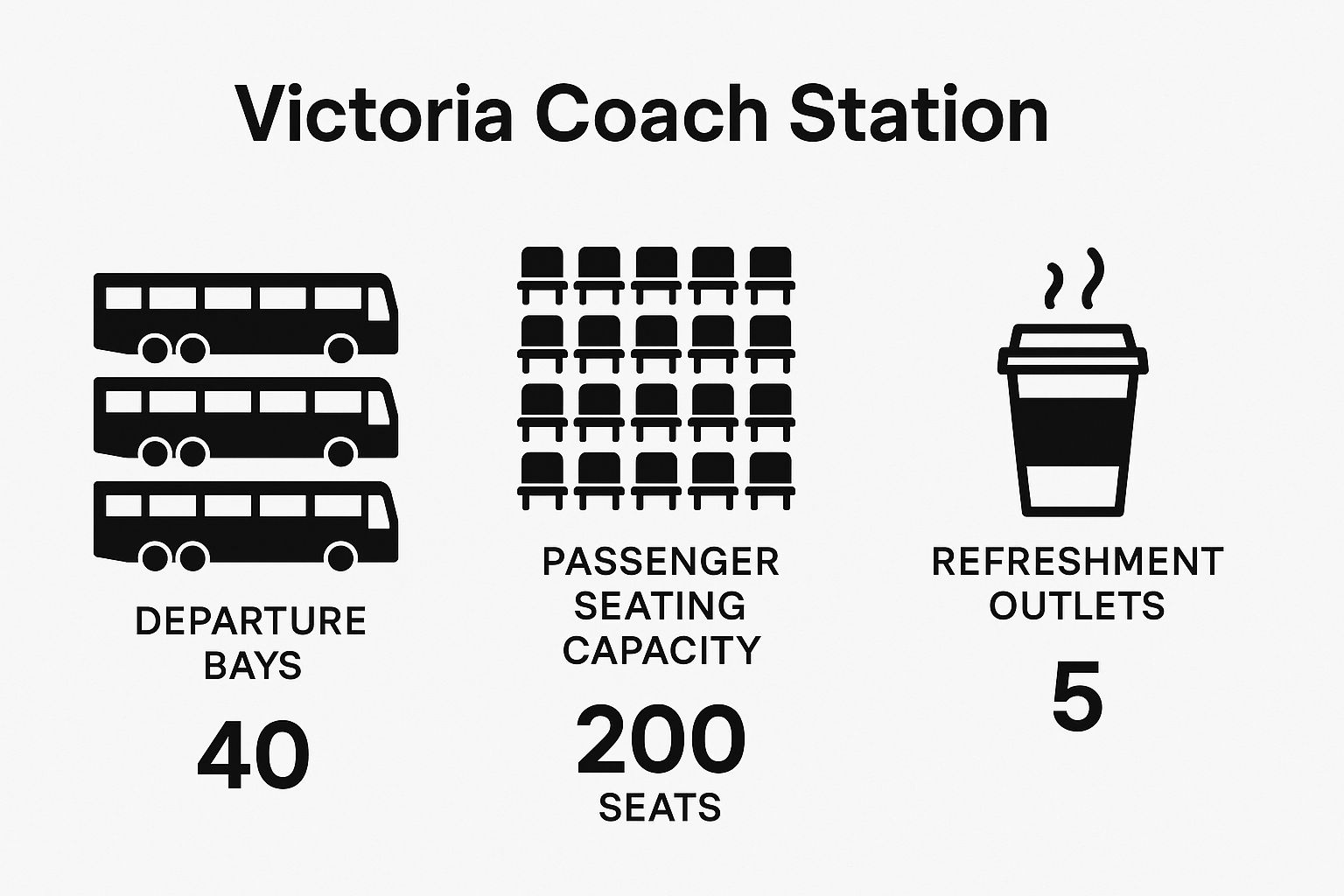
As you can see, while there are plenty of departure bays, seating and food options are a bit more limited. That makes getting there smoothly and on time even more crucial.
The Major Players in London
In London’s bustling private hire scene, a few big names dominate. First, you have the app-based giants Uber and Bolt. Their main advantage? On-demand speed. You can often get a car to your doorstep in just a few minutes. But there’s a massive catch: surge pricing. During busy periods, fares can suddenly shoot up, turning what you thought was a cheap ride into a surprisingly expensive one. This makes budgeting for your trip a real gamble, a common complaint within the UK taxi industry.
Then you have Addison Lee, one of London’s classic private hire firms. They’re known for professional drivers and quality cars, offering a reliable service, especially if you pre-book for something important like an airport run. That reliability, however, usually comes with a premium price tag, making them a less budget-friendly choice compared to app-based options. Also in the mix are apps like Gett and FREENOW, which connect users with licensed black cabs and private hire vehicles, offering another layer of choice.
A Modern Alternative
This is where a service like the Crisfix app comes in. It blends the ease of a modern app with the predictability of a traditional car service. Think about it: a family in Kensington with tons of luggage needs a bigger car (an MPV). With Crisfix, they can pre-book it and lock in their fare, completely avoiding the risk of Uber’s morning rush surge pricing. This model offers a solid pro: fixed, transparent pricing, which directly addresses the major con of competitors like Uber and Bolt.
It’s a different approach that a modern taxi app can offer.
Imagine you’re arriving at a London train station from Manchester or Birmingham. Instead of joining the taxi queue and hoping for the best, pre-booking a fixed-fare ride to Victoria Coach Station gives you total peace of mind. You know the exact cost and that the right size car will be there waiting.
This way, you get a much more predictable and custom experience. You’re not just rolling the dice on price and availability with Uber or Bolt; you’re scheduling your ride, choosing the exact vehicle you need, and knowing it’s all sorted.
Comparing Your Options Directly
So, what’s the right choice for your trip to Victoria Coach Station? It all comes down to what you value most. Are you chasing the lowest possible cost, instant availability, or guaranteed reliability?
This quick comparison table should help you figure it out.
Comparing London’s Top Ride-Hailing Apps
Here’s a breakdown of the most popular apps in London to help you choose the best fit for getting to the coach station.
| App Feature | Crisfix | Uber and Bolt | Addison Lee |
|---|---|---|---|
| Pricing Model | Fixed, upfront fares with no surge | Dynamic surge pricing based on demand | Premium fixed pricing, generally higher |
| Booking | Pre-booking and on-demand | Primarily on-demand, some pre-book | Strong focus on pre-booking |
| Best For | Predictable costs and planned trips | Spontaneous, last-minute journeys | Business travel and guaranteed quality |
| Vehicle Choice | Specific vehicle types (e.g., MPV) available | Standard, XL, and premium options | Fleet of high-quality, uniform cars |
In the end, while Uber and Bolt are great for spontaneous trips, services like Crisfix and Addison Lee deliver the reliability and fixed prices that make for a stress-free journey when you’ve got a coach to catch.
How To Book Your Ride With The Crisfix App
When getting to Victoria Coach Station is on your agenda, the last thing you want is to gamble with fluctuating fares or wonder if a car will even be available. This is where a modern app like Crisfix really shines. It lets you skip the guesswork and book your ride with confidence, so a car is waiting right when you need it.
The whole process is incredibly simple, designed to get you from A to B without the usual travel stress. It’s all about combining the ease of an app with the reliability of a pre-booked service.
Getting Your Booking Sorted
Once you’ve downloaded the app and set up your account, scheduling your trip takes just a few moments. Your first move is to pop in your pickup location and your destination—in this case, “Victoria Coach Station.”
Right away, the app shows you a fixed fare. That’s it. The price you see is the price you pay, which is a huge relief compared to the unpredictable surge pricing that often hits during London’s busiest hours. You can also pick the vehicle that suits you, whether it’s a standard saloon for a solo trip or a bigger MPV if you’ve got family and luggage in tow.
Here’s a look at the clean, simple interface you’ll be using.

The layout is designed to be straightforward, letting you choose your service, set your locations, and get a quote without any hassle. It makes the whole thing quick and painless.
A Real-World Booking Example
Let’s imagine you need to get from Canary Wharf to Victoria Coach Station right in the middle of the morning rush. Here’s how it would work:
- Enter Your Details: Open the Crisfix app, type in your Canary Wharf address for pickup, and set “Victoria Coach Station” as your drop-off.
- Get a Fixed Fare: The app instantly calculates a fixed price for that specific journey. No matter how bad the traffic gets, that price won’t change.
- Choose Your Car & Time: You select a standard car and schedule the pickup for 8:00 AM, giving you plenty of buffer to catch your coach.
- Track Your Driver: As soon as the booking is confirmed, you can watch your driver’s approach in real-time on the map. You’ll know exactly when to step outside.
This kind of control transforms a potentially chaotic trip across London into a smooth, managed experience. You’re getting a door-to-door service without the stress of hailing a cab or lugging bags on the Tube. It’s all about reliability and peace of mind.
This focus on dependability is part of a wider trend in on-demand services. If you’re curious about how this technology is adapted for other industries, you can see a similar model in action with this breakdown of a towing app like Uber. Ultimately, it’s all about putting you back in control of your journey.
The Enduring History of Victoria Coach Station
Victoria Coach Station is so much more than a place to catch a bus; it’s a living, breathing piece of London’s transport history. When it first opened its doors in 1932, motor coach travel was a fresh, exciting way for people to see the country, and the station’s gorgeous Art Deco design perfectly captured the glamour of this new age. It didn’t take long for it to become the undisputed heart of long-distance road travel in Britain.
This iconic building has seen nearly a century of British life unfold, adapting and evolving right alongside the nation itself. Its story is one of incredible resilience, mirroring the country’s journey from the pre-war years right through to the modern day.
A Journey Through Time
The station’s own timeline reads like a history of the nation. During World War II, for example, a large part of its yard was requisitioned by the War Office, and normal services were scaled way back. When services officially kicked off again on 22nd March 1946, it marked a real return to peacetime and gave people a renewed sense of freedom and mobility. The post-war boom that followed only cemented its place as a critical travel hub.
Fast forward a couple of decades to 1968, and the station fell under the control of the nationalised National Bus Company, a change that reflected the government’s approach to public transport at the time. It wasn’t until 1978 that the name “Victoria Coach Station Limited” was officially registered. After the National Bus Company was privatised, management eventually shifted to London Regional Transport, and since 2000, it’s been run by Transport for London.
You can see the full story of its changing ownership and governance in this fascinating research guide on the station’s evolution provided by TfL.
From serving a nation at war to operating under different public and private owners, the station’s ability to adapt shows just how vital it has always been. For millions of travellers coming in from places like Manchester, Birmingham, and Liverpool, it’s been a constant they can rely on.
Its Role Today
Even now, Victoria Coach Station is still the UK’s number one coach terminal—a testament to how important it was from the very beginning. It remains a crucial link in the country’s transport network, handling journeys for millions of passengers every single year.
So, for anyone planning a trip from London to Victoria Coach Station, knowing a bit of its history adds a whole new layer to the experience. You’re not just passing through a terminal; you’re stepping into a place that has been at the very centre of British travel for generations.
You can have a look on this link for an article about Find Taxis Near Me or on this link for an article about Transfers from Birmingham Airport. On this link is Booking a Taxi Glasgow Airport.
Your Travel Questions Answered
Heading into a major transport hub like Victoria can throw up a few last-minute questions, even for seasoned travellers. Whether you’re coming from another part of London or connecting from a city like Manchester or Birmingham, getting the small details right makes all the difference.
Let’s clear up some of the most common queries about getting to Victoria Coach Station so you can arrive relaxed and ready to go.
Arrival Time and Luggage
Figuring out when to arrive and what to do with your bags are two of the biggest hurdles when navigating a busy city.
How early should I get to the coach station?
The golden rule is to give yourself at least 30 minutes before your coach is scheduled to leave. Big operators like National Express and Megabus suggest this so you have plenty of time to check the departure boards, find your gate, and get your luggage sorted without that last-minute panic.
What’s the best way to travel with a lot of luggage?
If you’re wrestling with more than just a backpack, a pre-booked taxi or ride-sharing service is your best friend. Using an app like Crisfix lets you book a larger vehicle, like an MPV, to make sure all your bags fit easily. It’s a straight-shot, door-to-door service that saves you from dragging heavy cases through a packed Tube station or trying to squeeze onto a London bus.
Station Facilities and Payments
Once you’re there, knowing what’s available can make your wait a lot more comfortable. And of course, you need to know how to pay for your journey.
Are there facilities like toilets and food at the station?
Yes, Victoria Coach Station has everything you’d expect. You’ll find public toilets, plenty of seating in the waiting areas, and a main ticket office if you have questions. For food and drinks, there are a few cafes and shops where you can grab a coffee or a quick snack before you board.
A lot of people travel to the coach station from suburbs like Purley in South London. They usually take a train into Victoria Station first, and from there, it’s just a short walk over to the coach station. It’s a really common route for anyone connecting to services heading across the UK.
Can I use my contactless card on public transport?
Absolutely. For getting around on London’s Tube, buses, DLR, and other TfL services, using a contactless card or a payment app on your phone (like Apple Pay) is the easiest way to go. Just tap your card on the yellow reader when you start your journey and tap out again at the end if you’re on the Tube. It’s almost always cheaper than buying a paper ticket for a single trip.
For a completely seamless and stress-free ride directly to the station, with no surge pricing and the ability to choose your exact vehicle, book your trip with the Crisfix App.