


 by
by For drivers, taxi professionals, and towing operators, time is quite literally money. Every minute spent stuck on traffic represents a tangible loss in productivity, fuel, and potential earnings. The all-too-familiar sight of red tail lights stretching into the horizon doesn’t have to dictate your daily schedule or diminish your bottom line. The frustration of a complete gridlock is more than just an inconvenience; it’s a significant operational hurdle that impacts customer satisfaction and business efficiency.
This practical guide is designed specifically for those whose livelihoods depend on navigating our increasingly congested roads. Forget generic advice; we are diving straight into actionable strategies tailored for the modern professional driver. Inside, you will discover a curated list of tips, apps, and services created to help you reclaim your time. We’ll explore everything from advanced route planning and staying current with weekly industry news to making your enforced downtime productive. This article provides real, industry-specific insights to help you minimise delays, enhance operational efficiency, and turn lost hours into profitable opportunities. Let’s move beyond the frustration and explore practical solutions to conquer the commute.
1. Plan Your Route in Advance
The single most effective strategy to avoid getting stuck on traffic is to prevent it from happening in the first place. Proactive route planning using modern technology transforms your commute from a reactive struggle into a controlled, predictable journey. By leveraging real-time data, you can sidestep congestion, accidents, and road closures before you even turn the key in the ignition.
This approach goes beyond simply looking at a map. It involves actively using sophisticated apps like Google Maps, Waze, and Apple Maps to analyse live traffic conditions. These services gather data from millions of users, providing an accurate, up-to-the-minute picture of the roads. For professional drivers in the taxi and towing industries, this isn’t just a convenience; it’s a critical operational tool that directly impacts arrival times, fuel consumption, and customer satisfaction.
How to Implement Proactive Planning
Making route planning a habit is straightforward. Start by checking your preferred app 10-15 minutes before you plan to leave. This window is crucial as it allows you to see current conditions and make informed decisions without rushing.
- Set Your Departure Time: Don’t just check the route; use the “Depart at” or “Arrive by” features. This will show you predictive traffic patterns, helping you decide if leaving 15 minutes earlier or later could save you 30 minutes on the road.
- Save Alternative Routes: For regular trips like your daily commute, save two or three different route options. If your primary route shows sudden congestion, you can switch to a pre-vetted alternative with a single tap.
- Enable Smart Alerts: Turn on notifications for your common routes. Waze and Google Maps can proactively alert you to unusual traffic on your way to work, giving you time to adjust.
This bar chart provides a quick overview of the key considerations for route planning tools.
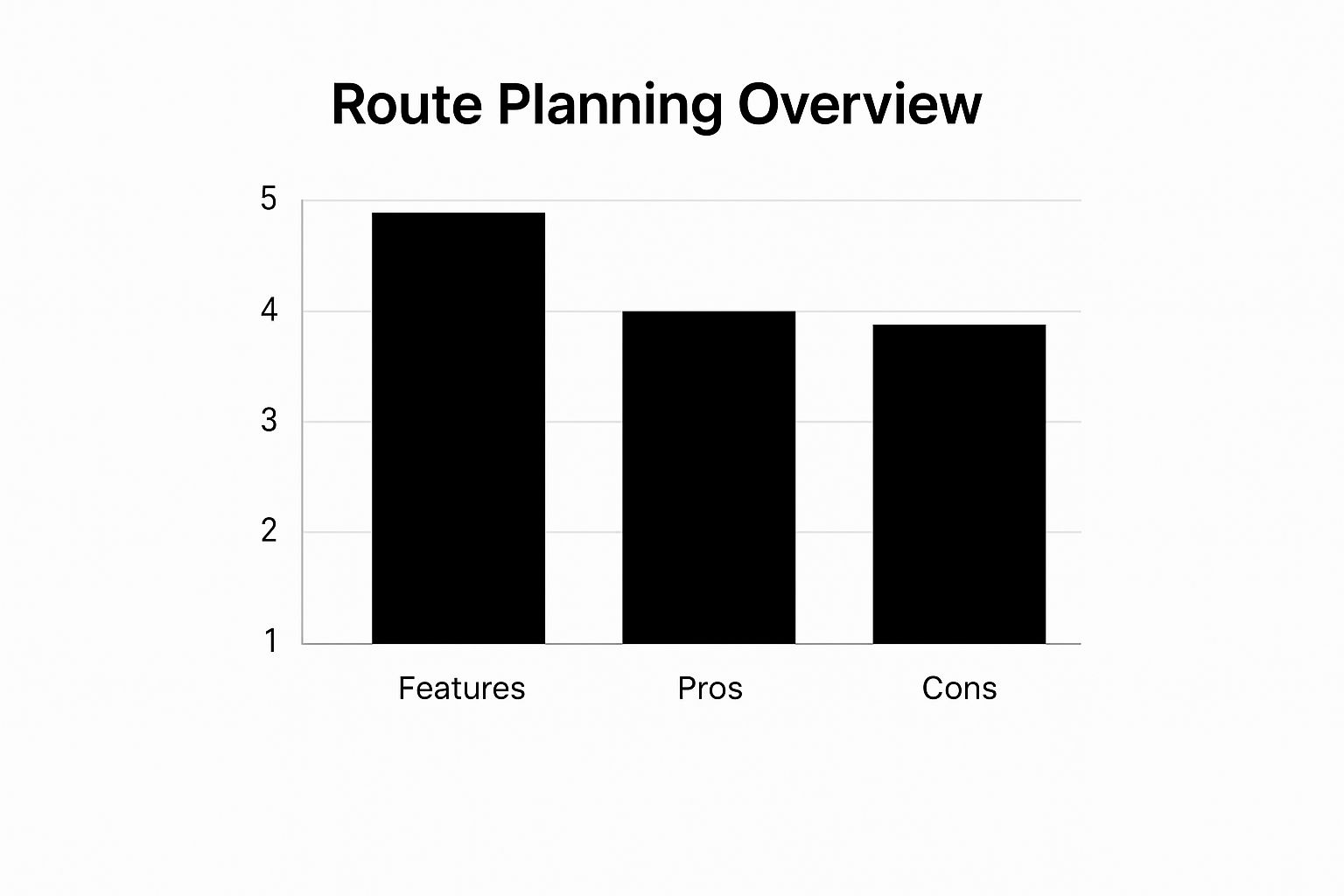
The visualisation highlights that while these apps are feature-rich and highly beneficial, users should remain aware of potential drawbacks like data usage and battery drain.
2. Leave Earlier or Later
Timing is everything, and when it comes to traffic, this saying holds profound truth. One of the most impactful, yet simple, strategies for avoiding congestion is to adjust your departure time. By shifting your travel to before or after peak rush hours, you can effectively sidestep the heaviest gridlock, turning a stressful, stop-start journey into a smoother and more predictable drive.
This tactic is built on understanding and leveraging traffic patterns. Morning and evening rush hours are typically the most congested periods as millions commute to and from work and school. For professionals in the taxi and towing industries, avoiding these peak times is a core part of operational efficiency. A driver who starts their shift slightly earlier can complete more fares or service calls before the roads become impassable, directly boosting their productivity and income. Successfully navigating the daily ebb and flow of traffic is key to avoiding being stuck on traffic.
How to Implement Time-Shifting
Making this strategy work requires a bit of planning and, in some cases, negotiation. The goal is to travel when fewer people are on the roads, which often means embracing a more flexible schedule.
- Analyse Your Route’s Patterns: Use the predictive traffic features in apps like Google Maps to identify the precise peak windows for your regular journeys. You might find that leaving just 20 minutes earlier in the morning cuts your travel time in half.
- Negotiate Flexible Working Hours: An increasing number of companies recognise the benefits of flexible schedules. Discuss the possibility of starting and finishing your workday earlier or later to miss the worst of the rush hour.
- Run Errands Strategically: Plan your shopping trips, appointments, and other errands for mid-morning, early afternoon, or later in the evening. This not only saves you time on the road but also means you’ll likely face smaller crowds and queues.
- Embrace Staggered Schedules: This is a proven method used by cities and large organisations. For example, some cities have implemented staggered school start times to reduce the morning traffic surge, a principle you can apply to your personal or business schedule.
3. Use Public Transportation
One of the most reliable ways to beat gridlock is to opt out of the car-centric equation entirely. Switching to public transportation, such as buses, trains, or trams, allows you to bypass the worst of the congestion, as these systems often operate on dedicated lanes and fixed schedules that are less susceptible to the unpredictability of road traffic. It’s a strategic shift from individual travel to a collective solution, turning a potentially stressful drive into productive or relaxing time.
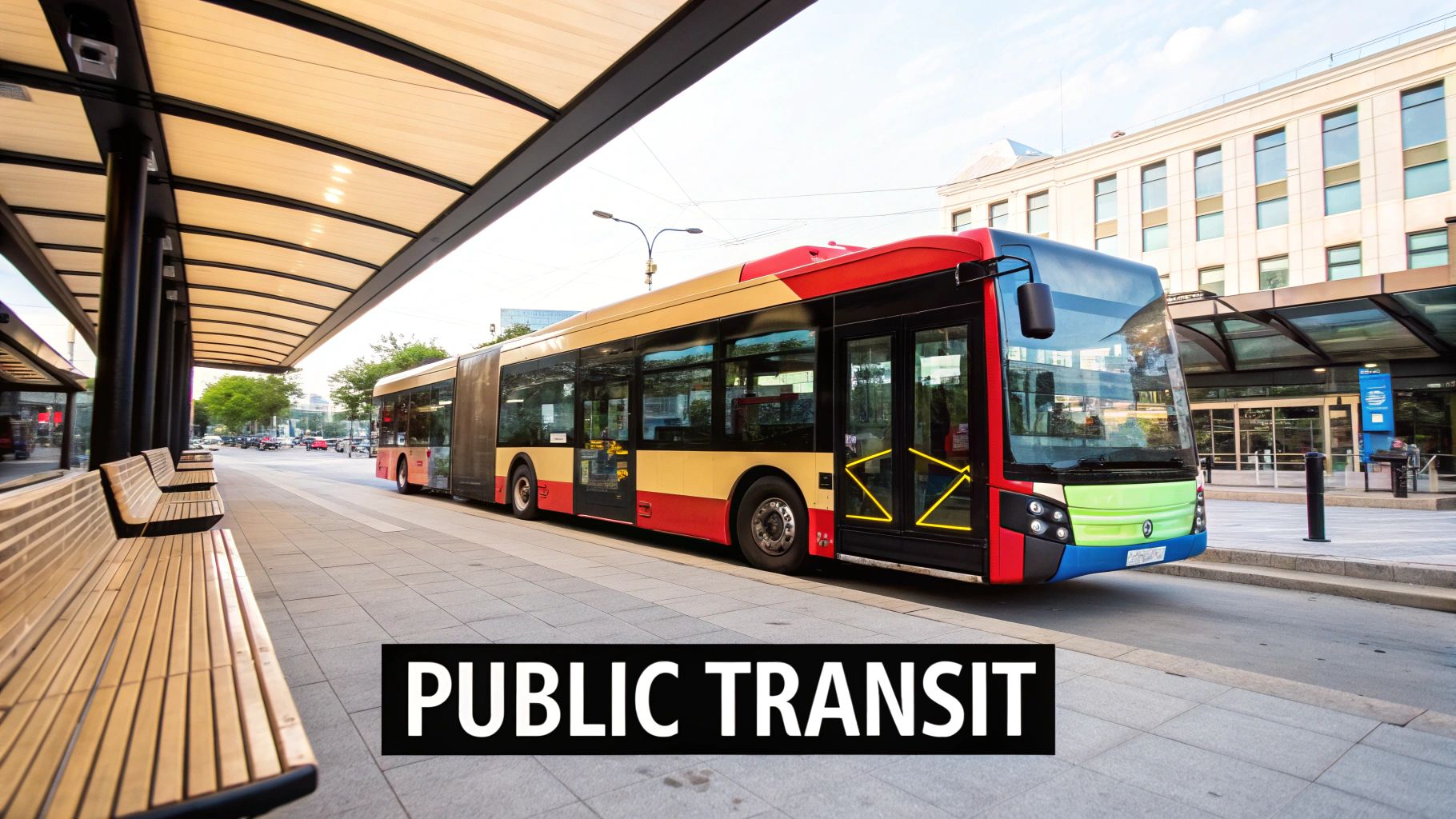
For professional drivers in the taxi or towing industries, understanding public transport patterns isn’t just about personal travel; it’s a competitive advantage. Knowing the major transport hubs and service disruption points can inform better pickup/drop-off strategies and help anticipate shifts in demand. For example, a major train delay can lead to a surge in taxi requests near the affected station, a key piece of industry news that savvy drivers can act on by following transport authority updates.
How to Integrate Public Transport into Your Routine
Making the switch effective requires a little planning, but the payoff in time and stress reduction can be substantial. Successful systems worldwide, like Transport for London (TfL), demonstrate how integrated networks can significantly cut commute times.
- Master the Apps: Download official transit apps like the TfL Go app or Citymapper. These provide real-time bus and train arrivals, service status alerts, and journey planning tools, which are indispensable for navigating the network efficiently.
- Get a Travelcard: For regular commuters, investing in a weekly or monthly Oyster card or using a contactless payment method is almost always more cost-effective than buying daily tickets. This small step simplifies your daily journey and reduces costs.
- Plan Your First and Last Mile: Public transport gets you from hub to hub, but you still need to get to and from the station. Combine your journey with walking, cycling, or even a short taxi ride for maximum convenience, especially in areas less serviced by public routes.
- Know Your Alternatives: Always have a backup plan. If your primary train line goes down, know which bus route can serve as an alternative. This level of preparation prevents minor service issues from derailing your entire day.
4. Work from Home or Remote Work
The most definitive way to avoid getting stuck on traffic is to remove the commute from your daily routine entirely. Working from home, or adopting a remote work model, has transitioned from a niche perk to a mainstream operational strategy for countless businesses. The global shift initiated by the pandemic proved that for many roles, productivity is not tied to a physical office, making this a powerful solution to the daily gridlock.
This approach completely sidesteps the unpredictability of road conditions. For individuals, it means reclaiming hours once lost to commuting, reducing fuel costs, and lowering vehicle wear and tear. For businesses, including those in service industries, embracing remote work for administrative roles can significantly streamline operations. Even for on-the-road professionals like taxi drivers and towing operators, having a remote support team means less overall traffic to contend with, making their essential journeys slightly easier. Companies like GitLab and Automattic have built entirely distributed workforces, proving its large-scale viability.
How to Implement Remote Work Successfully
Transitioning to a home-based work setup requires a structured approach to maintain productivity and well-being. The key is to replicate the positive aspects of an office environment while capitalising on the flexibility of being at home.
- Establish a Dedicated Workspace: Designate a specific area in your home for work. This creates a mental boundary that helps you focus during work hours and disconnect when the day is done.
- Maintain Regular Communication: Use tools like Slack, Microsoft Teams, and Zoom to stay connected with colleagues. Scheduled check-ins and clear communication protocols prevent feelings of isolation and keep projects on track.
- Invest in Reliable Technology: A stable, high-speed internet connection and the right equipment are non-negotiable. This is your link to your company and clients. This also means ensuring your personal vehicle is always ready for essential trips. Services that come to you, like a mobile tyre service available across the UK, are invaluable for maintaining your car without disrupting your remote work schedule.
- Set Clear Boundaries: Define your working hours and stick to them. It’s easy to let work bleed into personal time when your office is just a few steps away. A clear schedule is crucial for a healthy work-life balance.
5. Carpooling and Ride-Sharing
One of the most direct ways to combat congestion is to reduce the number of cars on the road. Carpooling and ride-sharing are powerful strategies that achieve exactly this, transforming a solitary, often frustrating commute into a collaborative and more efficient journey. By sharing a ride, you not only help ease traffic flow but can also gain access to faster High Occupancy Vehicle (HOV) lanes.
This approach is fundamentally about optimising resource use. Instead of four people driving four separate cars to similar destinations, one vehicle can serve all four. For professional drivers in the taxi and ride-hailing industries, this principle underpins services like Uber Pool and Lyft Line, which aim to maximise vehicle occupancy, reduce fares for customers, and lessen the overall number of vehicles contributing to jams. This model directly addresses the problem of being stuck on traffic by being part of the solution.
How to Implement Carpooling and Ride-Sharing
Integrating shared mobility into your routine requires a bit of planning but offers significant rewards in time and cost savings. The key is to find a reliable system that fits your schedule and comfort level.
- Utilise Vetted Platforms: Use established apps like BlaBlaCar or Waze Carpool. These platforms often include user ratings and verification features, adding a layer of security and trust to the process.
- Establish Clear Ground Rules: If you’re setting up a regular carpool with colleagues or neighbours, agree on the specifics upfront. Discuss schedules, cost-sharing for fuel and maintenance, and pickup or drop-off points to avoid future misunderstandings.
- Have a Backup Plan: While carpooling is reliable, situations can change. Always have a contingency plan, whether it’s public transport or a trusted on-demand service. Knowing your options, like those available on an all-in-one taxi app, provides peace of mind.
- Start with Colleagues: The easiest way to begin carpooling is with people you already know and trust who share a similar commute. Corporate carpool programmes are becoming increasingly common as businesses recognise their role in reducing commuter stress and environmental impact.
6. Alternative Transportation Methods
Sometimes, the best way to beat traffic is to get out of the car entirely. Embracing alternative modes of transport like bicycles, motorcycles, or scooters isn’t just a lifestyle choice; it’s a strategic move to reclaim your time. For short to medium distances, especially in congested urban centres, these methods offer unparalleled agility, allowing you to bypass gridlock and arrive at your destination faster and with less stress.
This approach involves shifting your perspective on what a commute can be. Instead of being a passive participant in a line of cars, you become an active navigator of your urban environment. Cities like Amsterdam have built entire cultures around bicycle commuting, demonstrating its large-scale efficiency. In densely packed areas like Los Angeles, motorcycle commuters often report cutting their travel time in half. For professionals in time-sensitive industries like taxi and towing services, understanding these alternatives can inform operational strategy, for example by anticipating reduced demand in areas with new cycle superhighways.
How to Implement Alternative Transport
Integrating these methods into your routine requires some planning and a focus on safety. Start by evaluating your most common journeys and see if they are suitable for a different mode of transport.
- Invest in Safety First: Your most crucial investment will be in proper safety equipment. This includes a high-quality, well-fitting helmet, visible clothing, and appropriate lights for your bicycle, scooter, or motorcycle.
- Know the Rules of the Road: Each mode of transport has specific laws. Familiarise yourself with local regulations for two-wheeled vehicles, including where you can legally ride, park, and navigate through lanes.
- Plan Weather-Proof Backups: Alternative transport is often weather-dependent. Have a reliable backup plan, whether it’s public transport or an on-demand service like Crisfix, for days with heavy rain or poor conditions. This ensures you’re never left stranded when you’re trying to avoid being stuck on traffic.
7. Stay Informed and Adapt
While proactive planning sets you on the right path, real-time adaptability is what keeps you moving. Traffic is a dynamic system, influenced by countless variables from accidents to sudden weather changes. Staying informed means actively monitoring conditions throughout your journey, allowing you to pivot your strategy at a moment’s notice to avoid getting stuck on traffic.
This continuous vigilance transforms a static plan into a live, responsive travel strategy. It involves more than just having a map open; it’s about tapping into a stream of live information. For professionals in the taxi and towing sectors, this is a core competency. A driver who hears a traffic reporter announce a lane closure on the M25 can reroute instantly, saving valuable time, reducing fuel costs, and ensuring a positive customer experience. Staying on top of weekly industry news about roadworks or new traffic schemes is also part of this professional toolkit.
How to Implement Real-Time Adaptation
Turning information into action requires having the right sources and knowing how to use them. The key is to create a personalised, multi-source information network that feeds you relevant updates without being distracting.
- Set Up Custom Alerts: Use apps like Google Maps or Waze to create specific alerts for your regular routes. You can set notifications for accidents, heavy congestion, or road closures, ensuring you receive critical information directly.
- Follow Official Channels: Your local highway authority or council transportation department often posts the most accurate, real-time updates on social media platforms like X (formerly Twitter). Following these accounts provides instant access to official information.
- Tune into Local Broadcasts: Keep a local radio news station on in the background. Their frequent traffic reports, often powered by live helicopter feeds and community call-ins, provide a high-level overview and can alert you to major incidents that apps might be slow to register.
- Join Community Groups: Platforms like Facebook and Waze have community-based groups where drivers share real-time observations. These can offer hyper-local insights, such as temporary traffic lights or minor obstructions that official sources might miss.
By combining these sources, you create a comprehensive picture of the road ahead. This allows you to verify information and make confident, adaptive decisions, ensuring you are always taking the most efficient route available and minimising your chances of being caught in an unexpected jam.
8. Make the Most of Traffic Time
Despite the best planning, sometimes getting stuck on traffic is simply unavoidable. Instead of letting frustration build, you can reframe this idle time into a valuable opportunity for personal growth, productivity, or mental relaxation. This strategy involves turning your stationary vehicle into a personal hub for learning, mindfulness, or catching up on important communications, all while keeping safety paramount.
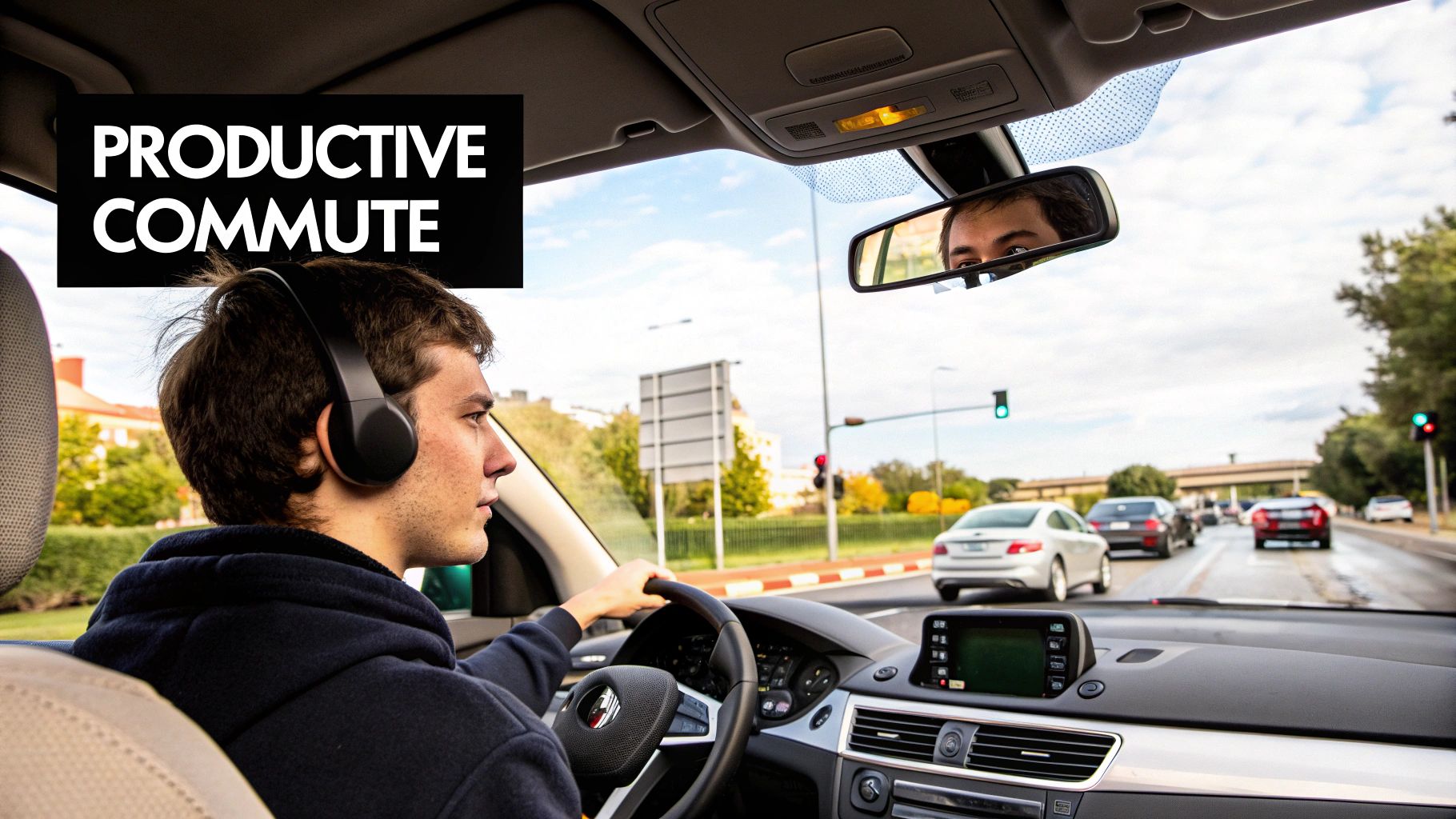
This modern approach to handling delays is particularly beneficial for professionals who spend significant time on the road, such as taxi drivers and towing operators. Transforming frustrating standstill moments into productive time can improve job satisfaction and mental well-being. For industry professionals, setting aside a small part of this time each week to listen to a transportation news podcast can provide valuable insights into new regulations, vehicle tech, or market trends.
You can see this link for Tyre Bead Sealant: A Fleet Manager’s Guide to Maximising Uptime article here or the here is the link for Your Guide to Using a Jump Start Battery Pack.
How to Implement Productive Downtime
Integrating this mindset into your driving routine is about preparation and prioritising safety. The key is to have your chosen activities ready to go before you hit the road, ensuring they are hands-free and do not distract you from your primary task of driving.
- Curate Your Content: Before your journey, download audiobooks, podcasts, or language lessons from platforms like Audible or Spotify. This prevents data usage issues in areas with poor reception. For industry professionals, this is a great time to catch up on weekly news or trends.
- Prioritise Hands-Free Operation: Ensure your smartphone is securely placed in a dashboard mount. Use Bluetooth connectivity to your car’s audio system for all content and calls, keeping your hands on the wheel and your focus on the road.
- Practise Mindful Moments: Use the time at a complete standstill to engage in simple stress-reduction techniques. Deep breathing exercises or short, guided meditations from apps like Calm can significantly lower stress levels associated with being stuck on traffic.
- Stay Prepared for the Unexpected: While making the most of your time is great, it’s also wise to be ready for genuine vehicle issues. Having a reliable service in mind means you won’t be stranded for long; learn more about dependable roadside assistance on crisfix.com to ensure you’re always covered.
8 Strategies for Managing Traffic Comparison
| Strategy | Implementation Complexity 🔄 | Resource Requirements ⚡ | Expected Outcomes 📊 | Ideal Use Cases 💡 | Key Advantages ⭐ |
|---|---|---|---|---|---|
| Plan Your Route in Advance | Moderate (Apps, data connectivity) | Smartphone/GPS, data for real-time updates | Reduced travel time & fuel use, better predictability | Daily commuters, unfamiliar routes | Real-time traffic info, alternative routes |
| Leave Earlier or Later | Low (Schedule adjustment) | Flexible work or activity schedules | Time savings, less congestion, improved fuel economy | Flexible schedules, non-fixed appointments | Avoids peak hours, simple to implement |
| Use Public Transportation | Moderate to High (Transit access & planning) | Ticket/pass purchase, transit stops access | Avoids congestion, cost-effective, eco-friendly | Urban areas, long commutes | Avoids traffic, productive travel time |
| Work from Home or Remote Work | High (Requires suitable jobs & infrastructure) | Reliable internet, home office setup | Zero commute time, higher productivity, better work-life balance | Knowledge/digital workers | Eliminates commute, reduces stress |
| Carpooling and Ride-Sharing | Moderate (Coordination & scheduling) | Ride-sharing apps or group coordination | Faster travel, cost sharing, reduced congestion | Group commuters, areas with HOV lanes | HOV lane access, cost & emissions savings |
| Alternative Transportation | Moderate (Safety gear & route planning) | Bike/scooter/motorcycle, safety equipment | Faster in congestion, health benefits, lower costs | Short urban trips, fitness-conscious | Cost-effective, health benefits |
| Stay Informed and Adapt | Moderate to High (Constant monitoring) | Access to traffic alerts & multiple sources | Reduced unexpected delays, better travel estimates | Daily drivers, variable routes | Proactive travel adjustments |
| Make the Most of Traffic Time | Low (Use of hands-free tech & content) | Hands-free devices, pre-downloaded content | Productive use of time, reduced stress | Drivers in heavy traffic | Turns delay into productive time |
Your All-in-One Solution for Smarter, Safer Journeys
Navigating the daily commute or a long-distance journey doesn’t have to be a battle against the clock. As we’ve explored, a proactive and flexible approach is your greatest asset in conquering congestion. From leveraging real-time data to adjust your route on the fly, to strategically shifting your travel times and embracing alternative transport, you have a powerful toolkit at your disposal. The core takeaway is that control is more attainable than you might realise.
Instead of passively accepting the frustration of being stuck on traffic, you can actively reclaim your time and reduce your stress. This involves a fundamental shift in mindset, from simply enduring the journey to mastering it. The strategies outlined, such as carpooling, utilising public transport, or even making your time in the car more productive, are not just isolated tips; they are interconnected components of a smarter travel philosophy. The true power lies in combining these tactics to create a personalised system that fits your specific needs, whether you’re a daily commuter, a professional driver, or a fleet manager.
The Value of a Comprehensive Strategy
For those whose livelihoods depend on the road, such as taxi and towing professionals, staying informed and agile is non-negotiable. The industry is constantly evolving, with new technologies and regulations shaping how services are delivered. Subscribing to a weekly industry news source is not just about compliance; it’s about maintaining a competitive advantage. Understanding emerging trends in traffic management, vehicle technology, and customer expectations allows you to offer a superior, more efficient service to your clients.
The ultimate goal is to build a resilient travel plan. This means not only having a primary strategy but also having robust backup options. What happens when your perfectly planned route is blocked by an unforeseen accident? What’s your next move when a tyre goes flat in standstill traffic? This is where preparation meets reality. Being equipped for the unexpected transforms a potential crisis into a manageable inconvenience.
From Reactive to Proactive Control
The difference between a frustrating journey and a smooth one often comes down to the tools you have on hand. While proactive planning is essential, having a reliable reactive solution is the other half of the equation. This is where an integrated service platform becomes invaluable. It acts as your on-demand safety net, centralising the solutions you need precisely when you need them most.
Imagine being able to summon a licensed taxi to complete your journey, request immediate roadside assistance, or even book a mobile car wash while you’re parked, all from a single, intuitive interface. This centralised approach empowers you to handle any situation with confidence, ensuring that a minor setback doesn’t derail your entire day. By combining the planning strategies in this article with a powerful, all-in-one support app, you move beyond just avoiding traffic; you gain complete command over your mobility.
You can see this link for Tyre Bead Sealant: A Fleet Manager’s Guide to Maximising Uptime article here or the here is the link for Your Guide to Using a Jump Start Battery Pack.
Ready to transform your travel experience from stressful to seamless? The Crisfix App consolidates licensed taxis, emergency towing, mobile tyre fitting, and on-site car care into one powerful platform. Stop letting traffic dictate your day and download the Crisfix App to unlock a smarter, safer, and more reliable way to navigate your world.
Article created using Outrank