


 by
by Right, let’s get you up to speed on the core rules for driving in the UK. At first glance, it might seem daunting, especially if you’re used to driving on the other side of the road. But don’t worry—the whole system is built around a few straightforward principles that keep traffic moving safely.
Whether you’re visiting for a holiday, a new resident finding your feet, or a professional driver in the taxi or towing industry, getting these basics down is absolutely essential. These aren’t just polite suggestions; they’re the law across the UK, from London to Manchester.
Interestingly, the rules we follow today have a long history. It all started with the Motor Car Act of 1903, which was the first time cars had to be registered and drivers needed a licence. Back then, a vehicle licence would set you back £1 a year, while a driving licence cost just five shillings (or 25p in today’s money!).
Your Guide to UK Road Regulations
So, what do you really need to know to drive safely and legally? It all boils down to a handful of key rules. Stick to these, and you’ll stay safe, avoid nasty fines, and keep your licence clean. Think of them as the foundation for every single journey you make, from a quick trip to the shops in Newcastle to a long haul down the motorway to Birmingham.
Here are the non-negotiables:
- Drive on the Left: This is the big one. In the UK, you must always drive on the left-hand side of the road. No exceptions.
- Give Way at Roundabouts: When you get to a roundabout, traffic already on it has priority. That means you need to give way to any vehicles coming from your right.
- Get Your Paperwork Sorted: Before you even turn the key, you must have a valid driving licence, current vehicle tax (also known as Vehicle Excise Duty), and at least third-party insurance.
- Watch Your Speed: Always stick to the speed limits shown on road signs. They change depending on the road type and whether you’re in a built-up area.
The Highway Code is your ultimate guide to UK road rules. It’s the official handbook for every road user—drivers, cyclists, and pedestrians alike. While the Code itself isn’t strictly law, many of its rules are. If you ignore them, it can be used against you in court.
For anyone driving for a living, like taxi or towing professionals in cities such as Liverpool or Newcastle, knowing these rules inside out is even more critical. Your business and reputation depend on keeping a spotless record and ensuring every passenger is safe.
Before we dive deeper, here’s a quick summary of the absolute must-knows.
Core UK Driving Principles at a Glance
This table breaks down the most critical rules every driver in the UK needs to have memorised. These are the pillars of safe and legal driving on British roads.
| Rule | Description | Why It Matters |
|---|---|---|
| Drive on the Left | Always keep your vehicle on the left-hand side of the road. | This is the most fundamental rule for preventing head-on collisions and maintaining traffic flow. |
| Roundabout Priority | At roundabouts, give way to traffic approaching from your right. | Following this rule ensures a smooth and predictable flow of traffic, preventing jams and accidents. |
| Valid Documentation | You must carry a valid driving licence, insurance, and have paid vehicle tax. | Driving without these is illegal and can lead to severe penalties, including fines, points, and vehicle seizure. |
| Obey Speed Limits | Adhere to the maximum speed indicated by road signs. | Speed limits are set for safety. Exceeding them is a leading cause of accidents and serious injuries. |
| Seatbelt Use | The driver and all passengers must wear a seatbelt if fitted. | Seatbelts are proven to save lives and reduce the severity of injuries in a crash. It’s a simple, life-saving habit. |
| No Mobile Phone Use | It is illegal to hold and use a phone, sat nav, or any device while driving. | Distracted driving is a major cause of crashes. Keeping your hands on the wheel and eyes on the road is crucial. |
Mastering these principles isn’t just about passing a test; it’s about developing the right instincts to navigate UK roads confidently and safely, every time you get behind the wheel.
Understanding UK Driving Licences and Requirements
Before you can legally get behind the wheel on any UK road, from the busy streets of London to the quieter routes in Newcastle, you need a valid driving licence. This isn’t just a bit of plastic; it’s your official proof that you have the skills and knowledge to drive safely.
For most people, the journey starts with a provisional licence, which you can apply for at 17. This licence lets you learn on public roads, as long as you’re supervised by a qualified driver and have ‘L’ plates on your car. It’s the very first step to getting your full licence in England, Scotland, or Wales.
Getting a full licence is a clear, structured path designed to create competent and confident drivers. This infographic shows you exactly what’s involved.
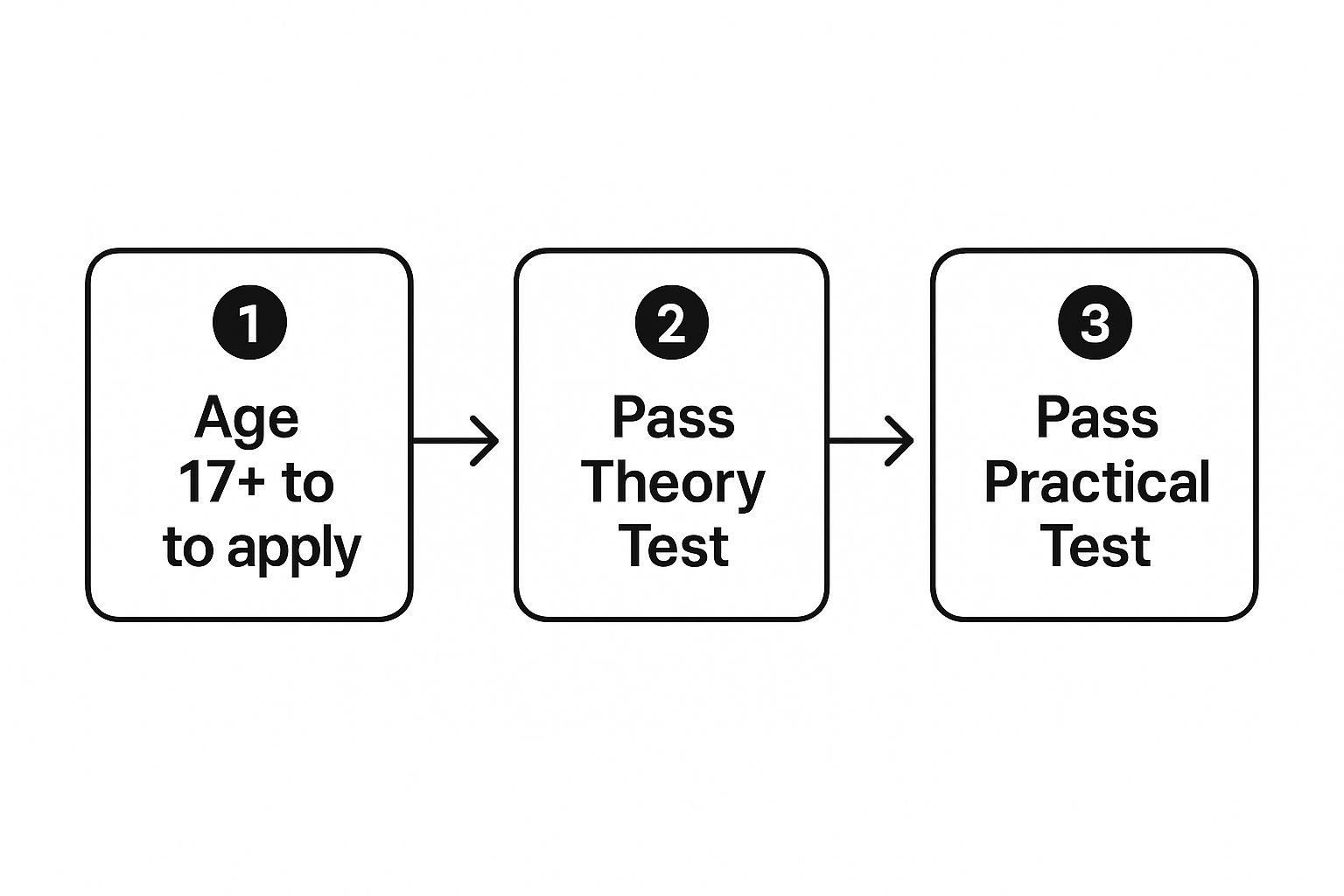
As you can see, the road from learner to licensed driver has three main stages: meeting the age requirement, passing your theory test, and finally, succeeding in the practical driving test. This process makes sure every new driver has both the book smarts and the real-world skills needed for UK roads.
Licence Categories and Professional Driving
Your standard UK driving licence (Category B) lets you drive cars. But for professionals in cities like Manchester and Birmingham—especially those in the taxi and towing industries—you’ll often need extra qualifications. Taxi drivers for companies like Addison Lee or those using apps like Uber, Bolt, or Gett must obtain a Private Hire Vehicle (PHV) licence from their local authority. For example, London’s Transport for London (TfL) has its own strict requirements.
Similarly, if you want to tow a large trailer or operate a recovery truck, you might need a Category B+E or even a C1 licence. It all depends on the combined weight of your vehicle and what you’re towing. This is a crucial consideration for towing operators across the UK.
The UK Penalty Points System
Think of your driving licence like a credit score for the road. Just as bad financial habits can wreck your credit score, driving offences add penalty points (or endorsements) to your licence. Get too many, and you could face serious consequences, including losing your licence altogether.
The penalty points system is there to discourage unsafe driving and keep motorists accountable. A minor offence might get you 3 points, while more serious ones can land you with 6 or more points and a hefty fine on the spot.
Most points stay on your licence for four years, but for really serious offences like drink driving, they can stick around for up to 11 years. The rules are even tougher for new drivers. If you’ve passed your test within the last two years, racking up just 6 points will get your licence revoked.
Maintaining Your Licence and Vehicle Documents
It’s a legal must to keep your driving licence and vehicle details up to date with the Driver and Vehicle Licensing Agency (DVLA). This means telling them if you change your name or address. To make things easier, the DVLA now has a Driver and vehicles account online, so you can manage everything in one place.
For professional drivers, this is non-negotiable. An out-of-date photocard or the wrong address could invalidate your insurance, leading to massive legal and financial headaches. A clean licence isn’t just a personal asset; it’s a professional one. It’s also smart to keep your vehicle in top shape; our guide on spring car checks every driver should do has some great tips.
If you’re coming from abroad, you might need to exchange your foreign licence. Drivers from EU/EEA countries can usually use their licence until it expires. But if you’re from other “designated countries,” you can only drive for up to 12 months before you need to swap it for a UK one, which might mean taking the UK driving test.
Mastering UK Speed Limits and Road Signs
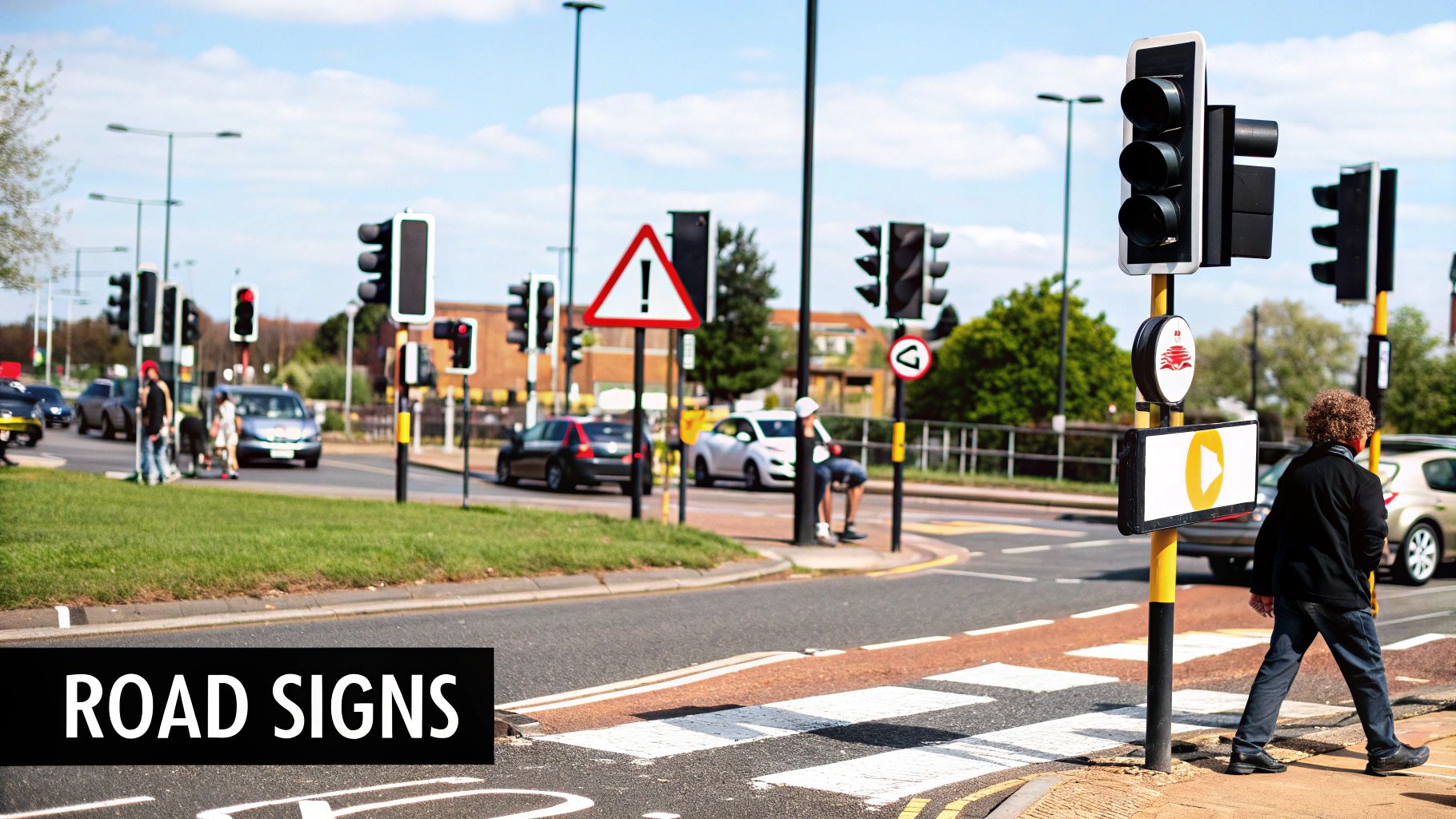
Beyond having the right licence, the two things that will keep you safe on UK roads are understanding speed limits and reading road signs correctly. These aren’t just helpful suggestions; they are strict legal rules that can change from one street to the next.
For professional drivers in the taxi and towing industries, who clock up hundreds of miles across cities like Newcastle and Liverpool every single week, getting this right is non-negotiable.
It’s funny to think how far we’ve come. Back in 1896, the UK’s first-ever speeding ticket was handed to Walter Arnold for doing a blistering 8 mph in a 2 mph zone. His fine? Five shillings. That incident kicked off a conversation that led to the limit being raised to a much speedier 14 mph that same year. If you’re curious about how our driving laws began, it’s worth a look. Discover more insights about cars and driving history in the UK.
Today’s system is a whole lot more complicated, with different limits for different roads and vehicles.
Understanding National Speed Limits
Unless a sign tells you otherwise, you’re expected to stick to the national speed limits. It’s your responsibility to know these by heart, as you won’t always see a sign reminding you. The correct limit depends on the road you’re on and, crucially, what you’re driving.
For standard cars, the national speed limits are pretty straightforward:
- 70 mph on motorways and dual carriageways
- 60 mph on single carriageways
- 30 mph in built-up areas (anywhere with streetlights)
But things change if you’re in a commercial vehicle or towing something. A car pulling a caravan or a recovery truck with a vehicle on the back is limited to 60 mph on motorways and just 50 mph on single carriageways. For anyone in the towing industry, that’s a massive difference and one you can’t afford to forget.
Decoding the Language of UK Road Signs
UK road signs are designed to be a quick, visual language. You should be able to understand them in a split second, thanks to a clever system of shapes and colours.
Here’s the basic grammar:
- Circles Give Orders: If you see a sign in a circle with a red border, it’s telling you what you must do (or not do). This includes the classic speed limit sign and “No Entry” signs. No exceptions.
- Triangles Give Warnings: A triangle with a red border is a heads-up. It’s warning you about a potential hazard just ahead, like a sharp bend, a crossroads, a slippery surface, or maybe deer crossing.
- Rectangles Give Information: These are your guideposts. They give you directions, tell you how far it is to places like London or Manchester, and point out services like parking or petrol stations. They’re usually blue for motorways, green for primary A-roads, and white for smaller, local routes.
Getting these signs right isn’t just about dodging fines; it’s about seeing the road ahead before you even get there. A warning sign for a sharp bend gives you precious seconds to slow down and adjust your line, which could be the difference between a smooth turn and a serious accident.
Speed Enforcement in Practice
Let’s put this into a real-world scenario. Imagine you’re a taxi driver doing a late-night fare across Liverpool. You’re on a dual carriageway where the national limit is 70 mph, but as you get closer to the city centre, temporary signs for roadworks knock the limit down to 40 mph. These zones are often littered with fixed and mobile speed cameras, and one moment of lost focus can mean points on your licence.
Or think about a towing operator working on a smart motorway outside Newcastle. The speed limit here isn’t fixed—it’s displayed on overhead gantries and can change dynamically to manage traffic. One minute it’s 70 mph, the next it could drop to 50 mph to ease congestion. Ignoring those digital signs is exactly the same as ignoring a metal one at the side of the road.
Staying alert is everything. And it’s not just about cameras. Police patrols are always active, especially in accident hotspots. For professional drivers, a clean licence is your livelihood, so treating every sign and every speed limit as a hard rule is simply part of the job.
Navigating Complex UK Road Situations
Anyone can drive from A to B on a quiet road. But the real test comes when you hit the busy towns and cities. Think of the intricate roundabouts in Birmingham or the packed junctions of London – these are the scenarios that demand sharp thinking and a solid grasp of the rules. For professional drivers in the taxi or towing game, getting this right isn’t just about efficiency; it’s about keeping everyone safe.
The secret is to see these situations not as chaotic obstacles, but as a well-choreographed dance. From the spiralling flow of a multi-lane roundabout to the patient timing of a box junction, each has a rhythm. Once you learn it, you can navigate them with confidence.
The Art of the UK Roundabout
Roundabouts are the lifeblood of UK roads, designed to keep traffic moving far better than stop-start traffic lights. The golden rule is simple: always give way to traffic approaching from your right. Easy enough. But on the bigger, multi-lane roundabouts, it gets a bit more involved.
The best way to think about it is like picking a lane for a turn at a normal junction:
- Turning Left (first exit): Stick to the left-hand lane on your approach and follow it around. Simple.
- Going Straight On (an intermediate exit): Check the road markings, but you’ll generally use the left or middle lane. Stay in your lane until you exit.
- Turning Right (last exit): This is the tricky one. Approach in the right-hand lane and stay on the inside as you go around the roundabout. Just after the exit before yours, signal left and safely move to the outside lane to make your turn.
Getting your lane discipline wrong, especially on a hectic roundabout in Manchester, can cause serious confusion. For a recovery driver with a vehicle in tow, a simple mistake can quickly escalate.
The Box Junction Dance
Ah, the dreaded yellow criss-cross box. Box junctions look intimidating, but their purpose is to stop junctions from getting clogged and causing gridlock. The rule is straightforward in theory but requires a bit of good judgement.
You must not enter a box junction unless your exit is clear. The only exception is if you are turning right and are only prevented from doing so by oncoming traffic or other vehicles also waiting to turn right.
This means you can wait inside the box if you’re turning right, but you absolutely cannot enter it to go straight ahead if your exit isn’t clear. It’s a delicate dance of timing and observation. Get it wrong, and you could block the whole junction and earn yourself a fine, especially in camera-monitored zones across London.
Special Rules for Professional Drivers
When you’re driving a taxi or a recovery vehicle for a living, you’ve got an extra set of rules to worry about, particularly in big city centres.
Loading and Bus Lanes:
Cities have strict rules about loading and unloading, usually marked by yellow lines on the kerb. Double yellow lines mean no waiting, ever. Bus lanes, marked by a solid white line, are usually only active during peak hours. Stray into one when it’s operational, and you’ll get a Penalty Charge Notice (PCN) in the post. For a taxi driver on a tight schedule in Birmingham or a towing operator in Liverpool, knowing the local rules is non-negotiable. For example, the 2A bus route in Manchester has specific operational hours for its bus lanes; professionals must be aware of these times to avoid fines.
London Congestion and ULEZ Charges:
Driving in central London means dealing with the Congestion Charge, a daily fee for entering the zone. On top of that, the Ultra Low Emission Zone (ULEZ) slaps another charge on vehicles that don’t meet strict emissions standards. While some vehicles, like licensed taxis, are exempt from the Congestion Charge, many private hire vehicles and older recovery trucks have to pay up. Forgetting to pay these charges leads to hefty fines.
Handling Emergencies and Breakdowns
Even the most skilled drivers run into trouble sometimes. If your vehicle breaks down, your number one priority is safety. A taxi driver from Birmingham once told me his engine died on a busy dual carriageway. His training kicked in instantly: hazard lights on, steer onto the hard shoulder, and get his passenger out on the grass verge, away from the traffic, before calling for help.
That’s exactly what you should do. If you break down:
- Flick on your hazard warning lights immediately.
- If you can, pull over to the left-hand side or onto the hard shoulder.
- Get out of the vehicle using the left-hand doors and wait behind a safety barrier if there is one.
- Call for roadside assistance. While traditional services like The AA and RAC are well-known, they can sometimes have longer wait times. An app like Crisfix offers an alternative, connecting you directly with local, vetted tow truck operators for potentially faster service to your exact spot.
Mastering these complex UK driving scenarios isn’t just about passing your test. It’s about building the experience and confidence to handle whatever the road throws at you.
Legal Responsibilities and Penalties for Driving Offences
Having a UK driving licence is more than just permission to drive—it’s a serious legal responsibility. Breaking the rules isn’t a minor slip-up; it can lead to hefty penalties that affect your wallet, your freedom, and your ability to make a living. This is especially true if you’re a professional in the taxi or vehicle recovery business.
Some offences are taken extremely seriously. The rules around drink and drug driving, for example, are razor-sharp, with precise legal limits that modern technology can easily detect right at the roadside. The same goes for using a handheld mobile phone while driving—it’s a complete no-go. Just touching your device is enough to land you in trouble.
Even something that seems small, like forgetting to wear a seatbelt, can earn you a fine. These aren’t just suggestions; they’re legal requirements put in place to keep everyone on the road safe.
From Fixed Penalties to Court Summons
If you commit a driving offence, the process usually kicks off with a Fixed Penalty Notice (FPN). Think of this as an on-the-spot fine that often comes with penalty points added to your licence. It doesn’t matter if you’re stopped by a police officer in central London or clocked by a speed camera on a motorway near Manchester; the result is the same.
You’ll typically have 28 days to pay the fine and accept the points. If you ignore it or decide you want to fight it, the matter gets passed to a magistrates’ court. That’s when things can get a lot more serious, with the risk of bigger fines, more points, or even being disqualified from driving altogether.
For a professional driver, your licence is your most vital tool. Whether you’re a taxi driver in Birmingham or a recovery operator in Liverpool, penalty points can directly threaten your job. They push insurance premiums through the roof and, in worst-case scenarios, can lead to your licence being revoked by the local council or the DVLA.
It’s crucial to understand how quickly a simple FPN can turn into a court summons. This really highlights why following every single driving law, from seatbelt use to speed limits, is so important.
Common UK Driving Offences and Penalties
To give you a clearer idea of what’s at stake, it’s worth knowing the common offences and the penalties they carry. The table below breaks down some of the frequent driving mistakes, their official codes, and what you can expect if you’re caught.
| Offence Code | Offence Description | Penalty Points | Typical Fine |
|---|---|---|---|
| SP30 | Exceeding statutory speed limit on a public road | 3 – 6 | £100 FPN |
| CU80 | Breach of requirements as to control of the vehicle, such as using a mobile phone | 6 | £200 FPN |
| IN10 | Using a vehicle uninsured against third party risks | 6 – 8 | £300+ FPN / Court |
| DR10 | Driving or attempting to drive with alcohol level above limit | 3 – 11 | Unlimited Fine / Court |
| LC20 | Driving otherwise than in accordance with a licence | 3 – 6 | £100+ FPN |
| TS10 | Failing to comply with traffic light signals | 3 | £100 FPN |
Knowing these codes and penalties helps you appreciate the real-world cost of a momentary lapse in concentration.
For professional drivers, these points are more than just a slap on the wrist. If you rack up 12 or more points within three years, you’ll almost certainly face a driving ban. This makes careful driving and maintaining a clean licence an essential part of your business strategy, not just good practice.
And if you do find yourself with a breakdown and need help without risking any more trouble, it pays to have a reliable service on standby. You can compare your options by reading our article on GreenFlag breakdown cover to see what kind of support is out there.
Evolving UK Highway Code and Driving Test

The rules of the road in the UK aren’t stuck in the past. They’re constantly being tweaked and updated to keep pace with modern traffic, new vehicle technology, and the latest safety research. Both the Highway Code and the driving test have changed dramatically over the years to better prepare new drivers for what they’ll actually face on busy routes in cities like London and Manchester.
This isn’t change for change’s sake; it’s all about making our roads safer. The driving test has come a long way since it became compulsory back in 1935. For example, learners had to demonstrate arm signals until 1975, a skill that became obsolete once electric indicators were standard. More recently, a major 2018 update finally allowed learner drivers onto motorways with an approved instructor, giving them crucial experience on high-speed roads.
Modernising the Driving Test
Today’s practical driving test is a world away from the one your parents or grandparents might have taken. The focus has shifted from simply proving you can handle a car to showing you can think for yourself and spot hazards on the road.
Here are the key changes that every learner needs to know:
- Independent Driving: This part of the test now lasts for 20 minutes, double what it used to be. It makes up about half the entire test.
- Sat-Nav Navigation: Most learners are now asked to follow directions from a sat-nav, a real-world skill that’s essential for pretty much every driver today.
- New Manoeuvres: Outdated manoeuvres like ‘reversing around a corner’ and the ‘three-point turn’ have been dropped. They’ve been replaced with more realistic situations, like pulling up on the right-hand side of the road.
Think of it like this: the old test was a checklist of mechanical skills. The new test is more like a simulation of a real journey. It’s testing your ability to make safe decisions, handle distractions like a sat-nav, and react to the unexpected.
Practical Tips for Today’s Learners
To pass the modern UK driving test, it’s no longer enough to just perfect your parallel park. It’s all about developing your situational awareness and learning to read the road ahead. Instructors in cities like Birmingham and Liverpool now dedicate more lesson time to tackling tricky multi-lane roundabouts and complex city junctions.
For learners, this means getting comfortable using a sat-nav and sharpening your hazard perception skills. It also means understanding that things can go wrong at any time. Knowing how to handle a minor breakdown safely is just as important as any manoeuvre. For those unexpected moments, having reliable backup is a must. Our guide on roadside assistance offers some great advice on getting professional help when you need it most.
Mastering these modern elements is your key to not just passing the test, but becoming a truly safe and confident driver on UK roads.
Your Top UK Driving Questions Answered
Let’s be honest, UK driving rules can feel like a maze. Just when you think you’ve got it all figured out, a new question pops up. This is true whether you’re a brand new driver or a seasoned pro running a taxi or recovery business.
Here, we’ll tackle some of the most common questions we hear, breaking them down into simple, practical answers you can actually use.
Can I Swap My Foreign Licence for a UK One?
This is a big one for anyone moving to the UK, and the answer depends entirely on where your licence was issued.
- From the EU/EEA? You’re in luck. You can keep using your current licence until it expires or you hit 70. No need to exchange it unless you want to.
- From a ‘Designated Country’? If your licence is from a place like Australia, Canada, Japan, or Switzerland, you can directly exchange it for a UK licence. The key is to do it within five years of becoming a resident here. No re-testing needed.
- From Anywhere Else? For all other countries, you get a 12-month grace period to drive on your foreign licence. After that year is up, you’ll need to apply for a provisional licence and pass both the theory and practical driving tests to get your full UK licence.
What Happens if I Get 12 Penalty Points?
This is the one every driver dreads. Racking up 12 or more penalty points on your licence within three years almost always leads to a driving ban. This is often called a ‘totting-up’ ban, and it typically lasts for six months.
For professionals working in the taxi or towing industries in cities like London or Manchester, this isn’t just an inconvenience—it can be career-ending. A ban directly impacts your livelihood and makes getting insured a nightmare.
Are Learner Drivers Allowed on the Motorway?
Yes, they are, but there are some very strict rules. A change in 2018 means learner drivers in England, Scotland, and Wales can now have lessons on motorways.
However, this isn’t a free-for-all. The lesson must be with an approved driving instructor, and the car must be fitted with dual controls. You can’t just hop on the M6 with a friend or family member for practice.
This rule was brought in to give new drivers real-world experience on high-speed roads before they pass their test. The idea is to build safer, more confident drivers on busy routes connecting major hubs like Birmingham and Liverpool.
When Do I Have to Report a Road Accident to the Police?
The law is very clear on this. You must stop and report an accident to the police if someone is injured or if there’s damage to another vehicle or someone else’s property.
At the scene, you have to give your name, address, and vehicle registration number to anyone who has a reasonable need for them. If for some reason you can’t exchange details there and then, you are legally required to report the accident at a police station as soon as you can, and always within 24 hours. Failing to stop or report an accident is a very serious offence.
When you’re stuck on the side of the road, whether it’s a flat tyre in Newcastle or a full breakdown on a busy motorway, you need help, fast. Instead of wasting time scrolling through endless search results, the Crisfix App gives you a single, reliable solution.
Instantly book a vetted local service for towing, tyre fitting, or roadside assistance right from your phone. With real-time tracking and secure payments, you get transparent, professional help exactly when you need it. Download the app today and drive with complete peace of mind.