

 by
by At its heart, a car breakdown recovery service is your professional lifeline when your vehicle gives up on you. It doesn’t matter if it’s a dead battery in Manchester, a mechanical meltdown near Birmingham, or a puncture in central London – these services are designed to either fix the problem on the spot or get your car to a garage, making sure you’re not left stranded. This guide provides the critical information you need to decide on the right service, whether you’re a private driver, a taxi operator, or part of the towing industry in the UK.
What Happens When Your Car Breaks Down
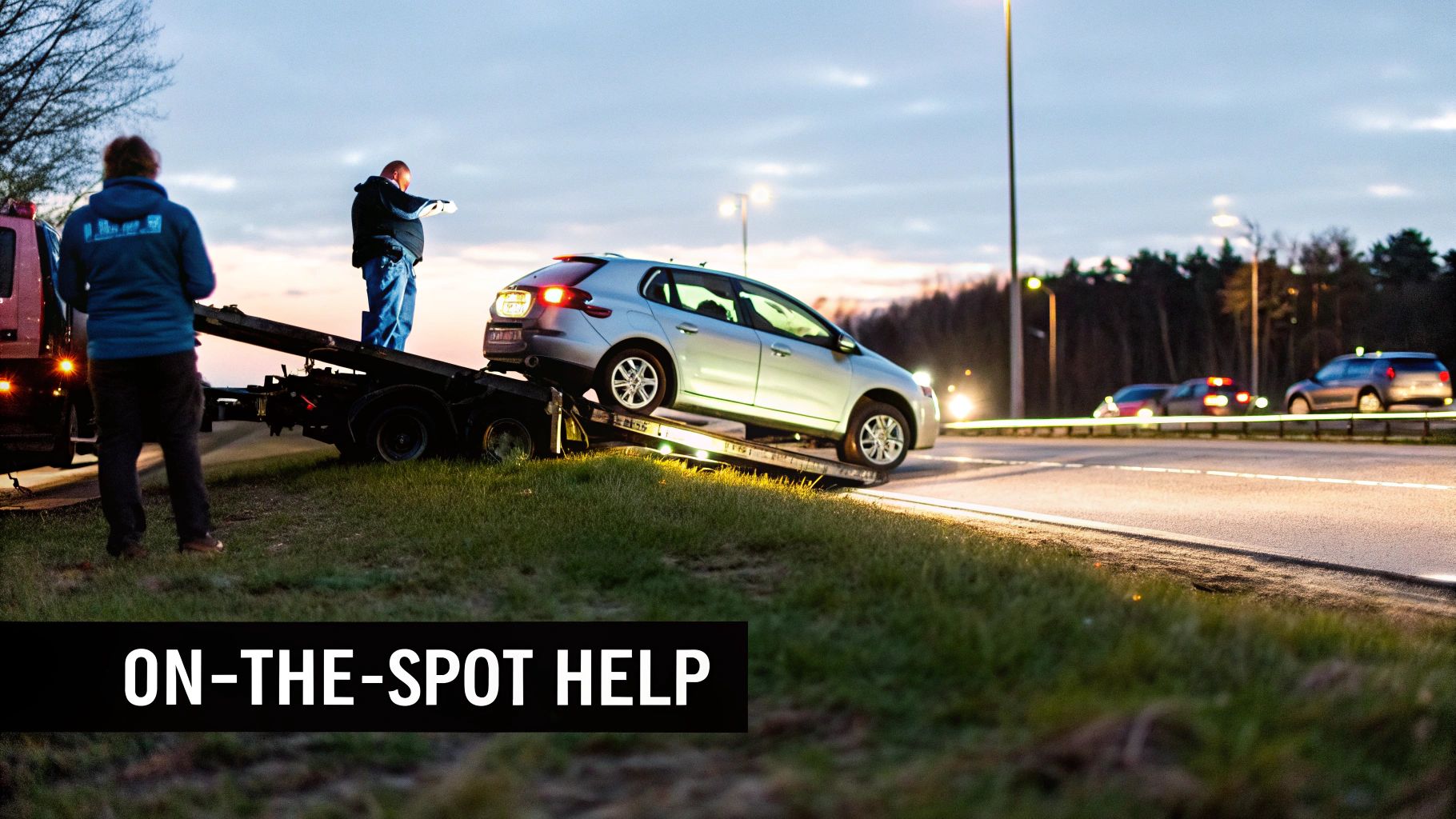
Picture it: you’re cruising down the M1 near Birmingham, and then, without warning, your engine sputters and you find yourself coasting onto the hard shoulder. That initial jolt of panic is something every driver dreads. But knowing what comes next can transform a nightmare scenario into a straightforward, decisive action plan.
From the moment you call for help, the entire goal is to get you moving again as safely and quickly as possible. The process follows a clear path, bringing order to an otherwise stressful situation.
The Initial Call and Assessment
First things first, you need to contact your provider. Whether you’re dialling a membership hotline or tapping on an app, you’ll need to give them a few key details. The operator will need your exact location, what kind of car you’re driving, and a rundown of what went wrong.
This first conversation is vital. It helps the service send the right person for the job. A flat battery in central London needs a different response than a major engine failure on a quiet road near Newcastle. Getting this right from the start means help arrives faster. For taxi drivers, this call is even more critical; lost time is lost income.
Key Takeaway: The more precise you are with your location and the car’s symptoms, the quicker and more effective the response will be. This accuracy directly impacts your downtime.
Roadside Repair or Full Recovery
Once the recovery professional arrives, they’ll do a quick check to see what’s really going on. Their number one aim is to get you back on your way right there and then. Thankfully, many common headaches can be solved at the roadside.
- Flat Battery: A quick jump-start is usually all it takes.
- Flat Tyre: The technician can typically swap it out for your spare wheel in minutes.
- Minor Mechanical Faults: Sometimes, it’s a simple fix like a loose wire that can be sorted on the spot.
But what if the problem is more serious? Think engine failure, a broken gearbox, or major damage after a bump. In those cases, a roadside fix just isn’t on the cards.
This is where the service shifts from roadside assistance to a full recovery. Your car will be carefully loaded onto a tow truck and transported to a safe location—be it your home, your trusted local garage, or the nearest approved repair shop, depending on your policy. This ensures you’re never left stranded, no matter how serious the breakdown.
Comparing UK Breakdown Cover Options
Let’s be honest, picking a breakdown service can feel a lot like choosing a mobile phone plan. You’ve got the old-school contracts versus the new, flexible pay-as-you-go options. Understanding the key differences is crucial to making a decision that fits your life and your wallet, whether you’re dodging traffic in London or cruising the open roads around Manchester. The right choice is the one that gives you peace of mind and minimizes financial or operational losses when you need it most.
Making a smart decision means looking past the big names and shiny headline prices. You need to weigh up what really matters for your situation.
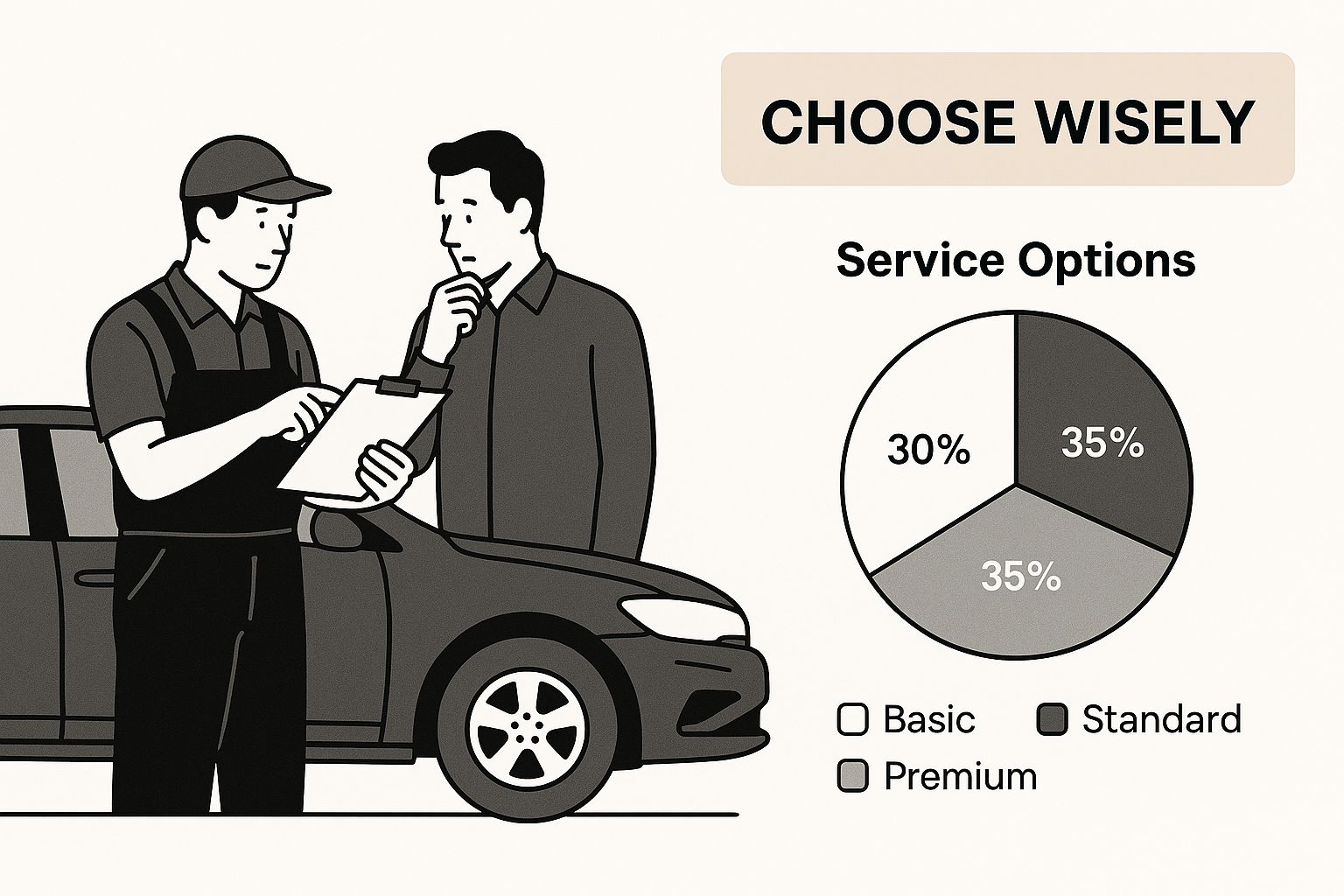
As you can see, it really boils down to a trade-off. Do you prefer the predictable, all-in-one comfort of a subscription, or the pay-when-you-need-it flexibility of an on-demand service? This choice decides your immediate and long-term costs.
To make it even clearer, let’s break down the two main approaches side-by-side.
Comparing UK Breakdown Service Providers
| Feature | RAC / The AA / Green Flag (Subscription) | Crisfix App (On-Demand) |
|---|---|---|
| Payment Model | Pay a fixed annual fee, whether you use the service or not. | Pay only when you actually need help. No upfront cost. |
| Cost Structure | Predictable yearly cost, but can be expensive if you rarely break down. Excess fees may still apply. | Costs vary per call-out based on time, location, and service. Transparent pricing upfront. |
| Flexibility | Locked into pre-set packages and a year-long contract. Upgrades can be costly. | Completely flexible. Request the exact service you need, when you need it. |
| Response Time | Dependent on patrol availability in your area; can involve longer waits, especially in peak times or remote areas. | Connects you to the nearest available local mechanic, often resulting in faster help in cities like London or Liverpool. |
| Included Perks | Often includes extras like onward travel or home start, depending on the plan tier. | Focused on the core service; extras are not bundled, keeping the core cost down. |
| Best For | Drivers who want all-inclusive cover, budget predictability, and are willing to pay for bundled features they may not use. | Infrequent drivers, city dwellers, taxi/ride-share operators who need fast response, or those who prefer to pay only for what they use. |
Ultimately, there’s no single “best” option—only what’s best for your specific needs and buying criteria.
The Traditional Big Players: RAC, The AA, and Green Flag
For decades, UK drivers have defaulted to the big three: The AA, RAC, and Green Flag. The model is simple and familiar: you pay an annual fee for a policy that covers you for a certain number of call-outs and a specific list of services. It’s the classic “peace of mind” purchase.
Pros (Why people choose them):
- Predictable Costs: You pay one fee for the year, making it easy to budget.
- Comprehensive Packages: They bundle everything—national recovery, onward travel, home start—into different tiers.
- Brand Trust: These names have been around forever, and that long-standing reputation offers a sense of security.
Cons (Why people look for alternatives):
- The Annual Fee: You pay it whether your car breaks down or not. For a reliable car or infrequent driver, this is a sunk cost.
- Rigid Packages: You’re often stuck in a pre-defined plan. If your needs change, you could be paying for features you’ll never use. For a closer look, you can learn more about how providers like Green Flag structure their breakdown cover.
- Slower Response Times: Despite large fleets, wait times depend on patrol availability in your area, from Liverpool to Birmingham. During busy periods, this can be a significant drawback.
The Modern On-Demand Alternative: The Crisfix App
A totally different approach has emerged with on-demand, pay-as-you-go services like the Crisfix app. Think of it like Uber, but for car trouble. Instead of paying an annual subscription, you just open the app and pay for help only when you actually need it.
This model is a decisive choice for many modern drivers, especially in the taxi and delivery sectors.
Pros (Why people are switching):
- Pay Only When Used: This is the biggest factor. No annual fees, no upfront costs. You only open your wallet when you’re actually stranded, maximizing cost-efficiency.
- Total Flexibility: You’re not tied to a contract or a list of features. You request exactly what you need right now, whether that’s a tow in Newcastle, a jump-start in London, or a tyre change in Manchester.
- Faster Local Help: Apps like Crisfix tap into a network of local, vetted mechanics. This often means a much faster response time because the nearest professional is sent your way, minimizing downtime.
Cons (Things to keep in mind):
- Variable Pricing: The cost of a call-out isn’t fixed. It can change based on time, your location, and the fault. However, the price is confirmed before you book, eliminating surprises.
- No Bundled Perks: Features like a hire car or hotel stays aren’t included. You’d have to sort and pay for those separately if needed, which keeps the core service lean and affordable.
At the end of the day, choosing the right car breakdown recovery service is a personal call. It’s all about balancing the security of a subscription against the smart, pay-as-you-go flexibility of on-demand help. Your decision should be based on a clear assessment of cost versus benefit.
Understanding the True Cost of Recovery
When your car grinds to a halt on the side of the road, the immediate stress is only half the battle. The other half? The cost. The final bill for a car breakdown recovery service often catches drivers by surprise, and understanding what you’re paying for is the best way to make a smart choice under pressure.
Many drivers across the UK assume a recovery service is a single, straightforward fee. But the reality is that the bill is often a moving target. Things like your exact location—whether you’re on a quiet country lane near Newcastle or stuck in rush hour on a London motorway—can completely change the price. You have to look past the headline number to see what you’re really getting.
By getting to grips with how different services charge, from annual memberships to one-off fees from local garages, you can avoid a nasty shock and choose a provider that offers genuine value.
Breaking Down the Bill
The price you’re quoted for recovery isn’t just pulled out of thin air. It’s a mix of several factors, especially if you’re using a pay-as-you-go service instead of a membership.
Here’s what typically goes into the final cost:
- The Initial Call-Out Fee: This is the base charge just to get a professional out to you. For independent mechanics and on-demand services, this usually lands somewhere between £75 and £150 before they’ve even touched your car.
- Time of Day and Week: A breakdown at 2 PM on a Tuesday in Birmingham is almost always going to be cheaper than one at 3 AM on a Sunday. Calling for help during unsocial hours means higher labour costs, and that gets passed straight on to you.
- Your Location’s Impact: If you’re stranded in a busy city like Liverpool or Manchester, help is probably just around the corner. But if you break down on a remote A-road or a major motorway, the extra time and mileage it takes to reach you often means extra charges.
- Mileage Charges: If your car can’t be fixed at the roadside and needs a tow, watch out for mileage fees. Some services charge around £1.50 per mile, which can add up fast if the nearest garage is a long way off.
Speed vs Service: The Cost-Benefit Analysis
When you’re stuck, your first thought is probably, “How fast can someone get here?” This is where you’ll find a clear trade-off between speed, the kind of help you get, and what you end up paying.
For instance, recent figures show Britannia Rescue is a frontrunner for speed, with its patrols reaching 23% of breakdowns in under 30 minutes and a massive 78% within an hour. On the other hand, a provider like Autoaid might focus more on getting your car to a garage, ultimately towing 57% of vehicles rather than prioritising a quick roadside fix. It just goes to show that the ‘best’ service really depends on what matters most to you in that moment. You can find more detailed comparisons to see how different providers stack up. For more insights, check out the latest on UK breakdown service response times on whatcar.com.
A super-fast response might come with a higher price tag, while a service that focuses on towing could have a completely different cost structure. Getting your head around this balance is key to managing your expectations—and your wallet—when you need help.
Your Options for Getting Home or to a Garage
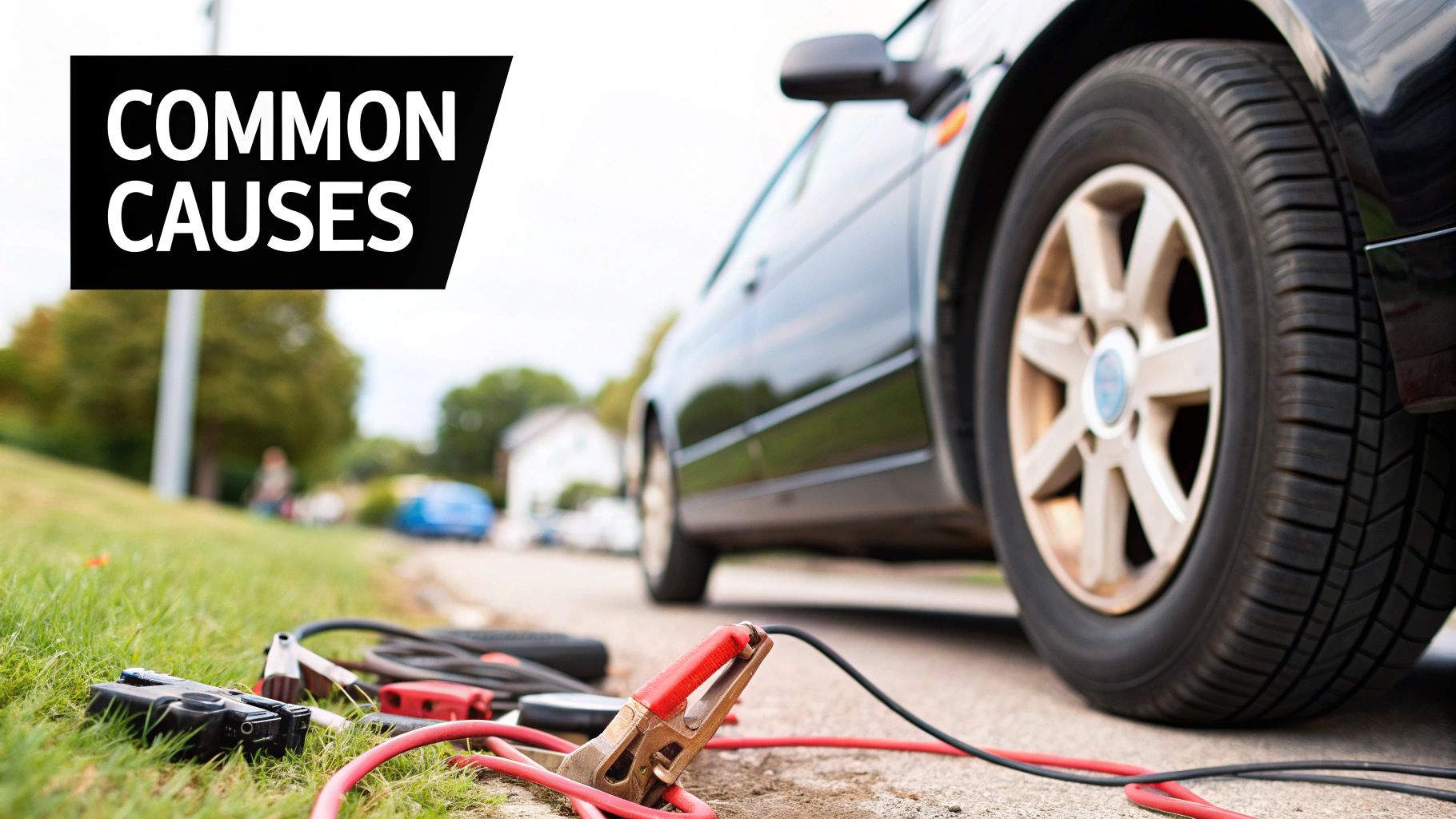
When a quick roadside fix is off the table, the question isn’t “Can it be fixed?” anymore. It’s “How do I get home?” This is where your car breakdown recovery service really kicks in, getting both you and your car to a safe place. What happens next all comes down to your policy and just how serious the problem is.
Knowing what your cover actually includes is crucial. It’s the one detail that decides where your car ends up, and understanding it means you can set your expectations right, whether you’re stranded in Liverpool or central London.
Local Recovery vs National Recovery
The biggest point of confusion for most drivers is the difference between local and national recovery. It’s a detail often buried deep in the small print, but it makes all the difference.
- Local Recovery: This is the standard you’ll find in most basic breakdown policies. If your car can’t be fixed at the roadside, it gets towed to the nearest suitable garage. This is usually within a 10-20 mile radius of where you broke down. It’s designed to get your car to a repairer quickly, but it doesn’t offer much choice.
- National Recovery: This is almost always an add-on or part of a pricier policy. It gives you the freedom to have your vehicle towed to any single destination in the UK. That could be your go-to mechanic back home, your workplace, or even just your own driveway.
Think of it this way: local recovery is about getting your car to the closest place for repairs, while national recovery is about getting it to the most convenient place for you. If you break down on a trip miles from home, local recovery could leave your car stranded in an unfamiliar town. National recovery gets it back where you want it.
Key Insight: Always check if your policy includes ‘National Recovery’. Assuming you have it can lead to a very expensive shock when you realise your cover only gets you to the next town over, not all the way home.
A Practical Example: Getting Home
Let’s make this real. Imagine you’re driving back into central London and your engine gives up on the M25 near the Dartford Crossing. A roadside repair is out of the question, and your basic policy only covers a local tow to a garage in Dartford. What happens now?
With your car being taken care of, your next problem is getting yourself home.
- Trip to the Station: First, you’ll need a taxi from the garage to Dartford Railway Station.
- The Train Journey: From Dartford station, you can take a Southeastern train service directly into a central London hub like Charing Cross. For instance, the 10:05 service from Dartford arrives at London Charing Cross at 10:50.
- Journey Time: That train ride usually takes about 40 to 50 minutes. During peak hours, services run approximately every 10-15 minutes, so you won’t be left waiting around for long.
- The Final Leg: Once you’re at Charing Cross, the Tube or a bus will get you the rest of the way home.
This simple plan turns a major headache into a manageable journey. For drivers who need help within the capital itself, knowing how a dedicated London towing service works can bring extra peace of mind.
Ultimately, whether you have local recovery and need to rely on public transport, or you’ve got national recovery sorted, the goal is the same. A good breakdown service ensures a car failure doesn’t leave you stranded, giving you a clear path to get everyone—and your car—safely to your destination.
When you think of getting roadside assistance, you probably just picture a tow truck showing up. But behind that single truck is a massive industry that keeps the UK moving. It’s not just a handful of companies; it’s a huge, complex network of national giants, local independent garages, and skilled professionals all working to get you back on the road.
The sheer scale of it is staggering. In 2024, the UK’s roadside assistance market was valued at around £1.8 billion. That said, it’s seen a bit of a slowdown, shrinking by about -2.5% each year for the last five years. A lot of that comes down to changing driving habits after the pandemic—fewer daily commutes in places like London and Manchester meant fewer breakdowns.
Still, it’s a critical industry with thousands of businesses involved. If you want to dive deeper into the numbers, there’s a great market analysis on ibisworld.com. This whole economic picture directly influences the help you get when your car gives up.
The Two Pillars of the UK Market
At its core, the UK breakdown recovery market really operates on two main models. They work differently, but they often work together.
- The Big National Players: These are the names everyone knows—The AA, RAC, and Green Flag. Their business is built on annual subscriptions. You pay a yearly fee for a policy that covers you for different situations. Their power comes from their brand name, a promise of nationwide cover, and the peace of mind that comes with a pre-paid plan.
- The Independent Network: This is the unsung hero of the breakdown world. It’s made up of thousands of smaller, local garages and recovery firms dotted all over the country, from Liverpool to Newcastle. These are the businesses that often work on a pay-as-you-go basis, either helping drivers directly or, more often, acting as the local support for the big subscription companies.
Industry Insight: Here’s something most people don’t realise: when you call out one of the big brands, the person who actually turns up is often from a local, independent firm. This clever hybrid system lets the national players have coverage everywhere without needing their own depots in every town.
Emerging Forces and Future Direction
Things are changing, and fast. While traditional subscriptions are still popular, technology is shaking things up. The rise of on-demand, app-based services like Crisfix is a perfect example. Drivers, taxi operators, and even small fleet managers increasingly want more control, flexibility, and clear pricing. These apps deliver just that by connecting them directly with a local, vetted mechanic in real-time.
This shift is pushing the entire industry to evolve. We’re now seeing:
- Real-time Tracking: Nobody wants to just sit and wait anymore. Customers expect to see their recovery truck approaching on a map, just like a Deliveroo order or an Uber.
- Enhanced Communication: In-app messaging and instant status updates are becoming the norm, taking a lot of the stress and guesswork out of the experience.
- Data-Driven Efficiency: Technology helps dispatchers find and send the closest available unit, which is a game-changer for cutting down wait times in congested cities like Birmingham.
For everyone—from the driver needing a tow to the taxi operator whose vehicle is their office—these changes in the market directly impact the speed, cost, and quality of the car breakdown recovery service they receive. The mix of established giants and nimble tech-driven independents is what keeps the industry competitive and constantly improving.
Future Trends in Breakdown and Recovery
The days of simply calling a number and hoping for the best are numbered. The car recovery industry isn’t just changing; it’s getting smarter, faster, and more connected. Technology is completely rewriting the script for how car breakdown recovery services operate, creating a system that’s more about prediction and prevention than just reaction.
This shift is a big deal for everyone. If you’re a driver in a busy city like London or Liverpool, it means help arrives quicker and is better prepared. If you’re in the taxi or towing business, it means it’s time to get up to speed with new vehicle tech and what your customers now expect. The old roadside support model is being rewired right in front of us.
The Rise of Connected Cars and Telematics
Think of modern vehicles as computers on wheels, because that’s what they are. Many are now fitted with advanced telematics systems that can figure out what’s wrong with them in real time. This is a game-changer. Instead of you trying to describe a weird clunking sound over the phone, your car can send a precise error code directly to the recovery service.
This self-diagnosis feature has massive benefits:
- Faster Dispatch: The recovery team knows exactly what the problem is before they even set off. This means the right mechanic with the right tools gets sent out the first time. No more guesswork.
- Predictive Maintenance: Some systems are smart enough to spot a potential fault before it becomes a full-blown breakdown, giving you a heads-up to get it fixed.
- Automatic SOS Calls: In a serious accident or system failure, many cars can now automatically call for emergency and recovery services, sending them a precise GPS location without you having to lift a finger.
AI and Smarter Diagnostics
Artificial Intelligence (AI) is the brain behind this new wave of breakdown support. AI systems can sift through data from thousands of vehicles, spotting common fault patterns and making diagnostics incredibly accurate. For a mechanic working in Birmingham, this means a much better chance of fixing the car at the roadside, saving everyone the hassle and cost of a tow.
For the towing industry, AI is also a logistics powerhouse. It can predict where breakdowns are most likely to happen in cities like Manchester, allowing companies to position recovery vehicles strategically. The result? Shorter waiting times and a much more efficient service all around.
The global market is feeling this tech-driven shift. Projections point to a steady compound annual growth rate (CAGR) of around 4.9% between 2024 and 2032, largely because of these innovations. The UK, as a key player in a European market that makes up over 30% of the global share, is right at the heart of this change. Companies are pouring money into mobile apps, telematics, and AI platforms to keep up. You can dig into a detailed analysis of the global car breakdown recovery service market on gminsights.com.
The Electric Vehicle Challenge
The boom in electric vehicles (EVs) on UK roads is a huge new chapter for the recovery industry, bringing both opportunities and tough challenges. While EVs have fewer moving parts, their electronic systems are far more complex than any petrol or diesel car. When an EV breaks down, it demands a whole new set of skills and equipment.
Recovery professionals now need specialised training to handle high-voltage batteries and systems safely. They also have to understand problems unique to EVs, like sudden battery drain or powertrain faults. You can’t just hook up any old tow truck; an EV often needs a flatbed to avoid damaging its electric motors. As the UK drives towards an all-electric future, the recovery industry has no choice but to invest in this new expertise to stay in the game.
Common Questions About Breakdown Recovery
Even when you know the basics, a few specific questions always seem to pop up, especially when you’re under stress. Let’s tackle some of the most common queries about using a car breakdown recovery service in the UK, so you can make a decisive choice.
Can I Get Breakdown Cover After I Have Already Broken Down?
Yes, you can, but your options change significantly once you’re already stranded. Traditional subscription services like The AA or RAC may offer you an ‘instant cover’ package, but this will come at a premium price and may have limitations on what’s covered for the immediate incident.
A much more direct—and often more cost-effective—decision is to use an on-demand service. Apps like Crisfix are designed for precisely this situation. They allow you to request, book, and pay for immediate help from a local professional without needing a pre-existing annual policy. This is the choice for immediate action.
Will a Basic Policy Tow My Car Home?
Almost certainly not. The vast majority of entry-level breakdown policies in the UK provide ‘local recovery’ only. This means they will tow your vehicle to the nearest suitable garage, typically within a 10-20 mile radius of the breakdown location.
To guarantee your car is taken to your home or a specific garage of your choice anywhere in the UK, you must have a policy that explicitly includes ‘national recovery’. This is almost always a premium add-on or a feature of a more expensive membership plan. You must decide if this extra cost is worth it for you.
What Is the Average Response Time in the UK?
This varies significantly. Response times are influenced by your location (e.g., central London vs. rural Newcastle), the time of day, and how busy the provider is. While the big national names often quote a 40 to 60-minute average, this can be much longer in remote areas or during peak demand.
This is where on-demand services that leverage a network of local mechanics can offer a decisive advantage, especially in cities like London, Manchester, or Liverpool. By dispatching the closest professional, they can often cut wait times significantly, which is critical for a taxi driver losing fares or a family trying to get home.
When your car gives up on you, you need help that’s fast, reliable, and doesn’t involve complicated contracts. Forget getting locked into an annual plan. Get the help you need, right when you need it, with the Crisfix App. Download it now and connect with a vetted local professional in minutes. https://crisfix.com